If a letter from Sydney Water says a backflow test is due, or the strata manager has put one in the maintenance budget, the first question is usually what the thing even is. The second is whether you can ignore it. If you have a testable device, you cannot. But plenty of people who search for this have nothing to test at all, and it takes about five minutes to work out which group you are in.
Backflow is water running the wrong way: out of a property and back into Sydney Water's pipes, carrying whatever it picked up on the way. Sydney Water's own list is chemicals, oil, bacteria and debris. A backflow prevention device stops it with a one-way valve, an air gap or a break tank. Around Parramatta the question comes up far more often than in most of Sydney, because most people here live in apartment buildings and heavy industry still runs 1.5 km east of the CBD. If you would rather have someone check it for you, the licensed plumbers in Parramatta on this site can tell you what you have.
A standalone house on a normal 20 mm or 25 mm meter almost certainly has nothing to test, because the meter has a backflow device built in. The yearly test applies to separate testable devices, which belong on bigger meters, fire services, below-ground rainwater tanks and any business with an on-site process. That is why it comes up so often in Parramatta's apartment buildings and on its industrial land, and the test is the owner's or the owners corporation's job.
- Check the meter size: 20 or 25 mm on a house usually ends the question
- Look for a separate valve assembly with test points after the meter
- Get an accredited backflow plumber to confirm the hazard rating
- Book the yearly test when Sydney Water's reminder arrives
- Have the result lodged within 2 days and keep the report
On this page
1. Check your water meter size first
Start at the water meter, because for most houses this is where the question ends. Sydney Water's 20 mm and 25 mm meters have a backflow device built into them, and Sydney Water says that satisfies its requirement for properties with a low cross-connection hazard, such as most stand-alone homes.
So if you own a house, lift the meter lid and read the size off the meter body or the dial. Sydney Water says meters usually sit just inside the front boundary or fence. A 20 mm or 25 mm meter on a house with no business, no fire service and no below-ground rainwater tank is the end of it: there is no separate device and nothing for anyone to test each year. If someone knocks on the door offering a backflow test on a house like that, ask them which device they mean.
There are two common exceptions on residential blocks. A below-ground rainwater tank that is topped up from the mains needs a vented dual check valve with an atmospheric port, while an above-ground tank on a 20 mm or 25 mm meter needs no extra protection. And a home that is also a workplace, a home salon or a workshop with chemicals, is no longer the simple case the built-in device was designed for.
In an apartment building you will rarely be able to get at the meter yourself. The strata manager or building manager can tell you the meter size and whether a device on it is registered with Sydney Water.
2. Look for a testable device after the meter
If your meter is bigger than 25 mm, or the property has a fire sprinkler or hydrant service, look on the pipe just after the meter for a separate valve assembly with small test points on top. That is a testable device, and it means the yearly test applies to you.
What Sydney Water requires depends on the hazard rating of the site:
- Low hazard on a meter larger than 25 mm: a non-testable device, usually a dual check valve straight after the meter. No yearly test.
- Medium hazard: a testable double check valve on a drinking water connection, or a double check detector assembly on a fire service.
- High hazard: a reduced pressure zone device, a registered break tank or a registered air gap.
Fire services have rules of their own. Every sprinkler or fire service connection needs a testable double check detector assembly near where the service enters the property, with no galvanised pipe upstream of it. Window and wall drencher systems need a non-testable low hazard device instead.
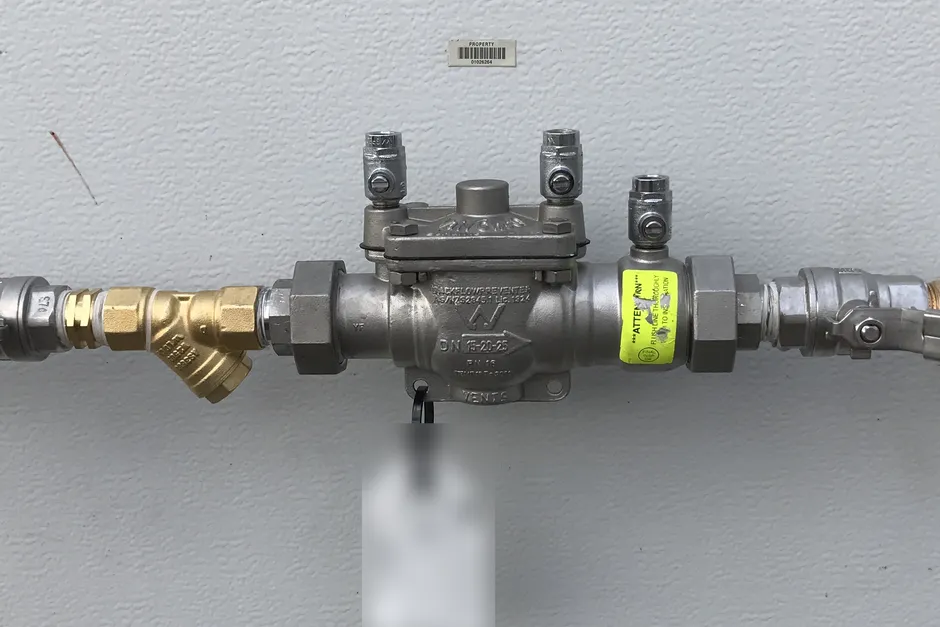

3. Get the hazard rating from an accredited backflow plumber
If there is a device, or you think the site should have one, get an accredited backflow plumber to rate the hazard. Sydney Water uses three ratings, low, medium and high, assessed against the examples in AS/NZS 3500.1, and the rating decides which device the connection needs.
Not every plumber can do this. Sydney Water only accepts inspections, commissioning and tests on medium and high hazard devices from licensed plumbers who also hold backflow accreditation from a registered training organisation. It is fair to ask to see it before the work starts.
Three rules catch people out. Owners of commercial or industrial properties, and any property with an on-site process, must get the rating done, and Sydney Water classes a site with no assessment as high hazard. A site with more than one connection needs a device on each. And the rating has to be reassessed whenever what happens on the site changes, so a warehouse that becomes a food business, or a shopfront that becomes a medical practice, may need a different device from the one it already has.
4. Book the yearly test before the reminder runs out
Book the test as soon as the reminder arrives. Medium and high hazard devices must be tested when they are installed and every year after that, by an accredited backflow plumber, and Sydney Water keeps a register of every testable device and sends a reminder when one is due.
If the test still is not done, Sydney Water can arrange it and send the owner the bill. Its 2026-27 business price list puts its annual backflow test at $553.12 including GST, and $431.68 if it turns up and cannot get access. The same price list also carries a backflow administration fee of $11.05 a quarter, one per property. Beyond the fees, Sydney Water can restrict the water supply or disconnect a property that does not have the right protection, which for a business or a residential tower is a far bigger problem than the test.
The practical answer is to treat it like any other annual compliance date. Put it in the calendar, use the same accredited tester each year if you can, and book a few weeks ahead so the date does not slide.
5. Make sure the result is lodged, and keep the report
Ask the plumber to lodge the result and send you a copy of the report. Sydney Water asks for test results to be lodged within 2 days, through its online backflow portal, and a newly installed testable device has to be registered straight away.
Photos are not required with the upload, but Sydney Water audits lodgements and can ask for two: one of the device with its serial number visible, and one of the test kit used. A good tester takes both on the day. Keep the report with the building's other compliance records. If you are selling, buying or changing strata managers, it is the document that proves the device was tested.
6. Repair or replace a failed device straight away
If the device fails its test, have it repaired or replaced and tested again, rather than leaving the failure sitting on a report. Sydney Water audits a sample of installations and sends a notice to repair, maintain, test or replace any device that does not comply.
This is licensed work, and not only in the obvious way. The owner and occupier exemption in section 4(5)(e) of the Plumbing and Drainage Act 2011 lets you repair a tap or showerhead in your own home, but it spells out the exception: "other than a repair of a thermostatic mixing valve, tempering valve or backflow prevention device". So even a dripping relief vent on a device in your own home is not a weekend job. The same carve-out covers the tempering valve near your hot water unit.
Backflow test due?
Not sure what is on your meter, or need a failed device sorted? A licensed Parramatta plumber can take a look.
7. Why backflow comes up so often around Parramatta
In a suburb of houses, backflow is a question for the local shops and the odd factory. Parramatta is not that suburb, for four reasons.
Most people here live in apartment buildings. At the 2021 Census, 85.6% of occupied homes in the suburb of Parramatta were flats or apartments, against 21.7% across NSW, and there were only 903 separate houses. Most residents' water therefore arrives through a building's service, not a house meter. If that building has a meter larger than 25 mm or a fire service connection, it has at least one device on the register, and the test is a building cost every year.
Heavy industry is next door. City of Parramatta describes Camellia, 1.5 km east of the CBD, as predominantly industrial. The Camellia-Rosehill Place Strategy, finalised by the NSW Government, keeps the precinct's heavy industrial land while planning for up to 15,400 jobs and 10,000 new homes. Sydney Water's list of what backflow can carry, chemicals, oil, bacteria and debris, reads like an inventory of an industrial estate, which is why commercial and industrial owners must have their rating assessed rather than assume one.
Some of that land runs on recycled water. The privately operated Rosehill scheme, licensed through IPART, makes recycled water from treated effluent sourced from Sydney Water and supplies it to industrial customers in Smithfield, Rosehill and Camellia. Sydney Water requires backflow containment on all drinking and recycled water connections, and where a site has both kinds of pipe side by side, a cross connection between them is exactly the failure this protection exists to stop.
The building never stops. Sydney Water treats a construction site building anything more than a single standalone house as high hazard, and requires a device on it. Between the CBD and Westmead towers and the homes planned for Camellia-Rosehill, there are a lot of those sites around here, and a builder's site meter is subject to the same register as any other device.
8. Apartments and strata: who pays for the test
The standard NSW common property memorandum, which many schemes have adopted, does not mention backflow devices at all. Its plumbing list for the owners corporation covers floor drains and sewers in common property, pipes within common property walls, floors and ceilings, the main stopcock to each unit, and below-ground stormwater and on-site detention systems.
A containment device sits on the building's incoming supply, before the water reaches any lot, which points to the owners corporation rather than an individual owner. If it is common property, the test and any repair come out of the levies. Your by-laws can say otherwise, so check them, and ask the strata manager for the most recent test report. We cover the wider split in strata plumbing: who pays.
If you rent, the test is not yours to arrange or pay for. Sydney Water puts the responsibility for the right device on the property owner. In a townhouse complex with a shared fire service or a single large meter, the same logic as an apartment block applies: one device, one owners corporation, one yearly test.
One more thing worth checking in a strata building is who actually does the test. If the fire services contractor does it, confirm they hold backflow accreditation and that the result was lodged, because a test that never reached the register looks to Sydney Water like no test at all.
9. Five things that make it worse
- Letting the reminder sit. A missed test can become Sydney Water's test at $553.12, and an ignored notice can end with a restricted supply.
- A hose left in a pool, bucket or tank. Sydney Water names submerged hoses as one way contaminated water gets back into the drinking supply. On a house, this is the backflow risk most people actually create.
- Changing what the site does without a new rating. A new tenant, a new process or a new use can change the hazard, and the old device may no longer be the right one.
- Adding a below-ground rainwater tank with mains top-up and no valve. It needs a vented dual check valve with an atmospheric port.
- Getting an unaccredited or unlicensed person to touch it. The repair is excluded from the owner exemption, the test needs accreditation, and a report from the wrong person will not be accepted.
10. When it is urgent and when it can wait
Treat it as urgent if the water looks, smells or tastes wrong after work on the site, after a pressure drop or after a device has failed its test, and stop drinking it until you know why. Report it to Sydney Water and get a licensed plumber out. A reduced pressure zone device that keeps dumping water from its relief vent is also worth a prompt call, because it usually means something inside is not sealing.
A reminder letter is not an emergency. Book the test within the next few weeks. And if you own a house on a 20 mm or 25 mm meter with nothing unusual on the property, you may not need anyone at all. We would rather tell you that than sell you a test for a device you do not have.
- Sydney Water's 20 mm and 25 mm meters have a backflow device built in, which covers most stand-alone homes.
- Testable devices sit on bigger meters, fire services and commercial or industrial connections, and they are tested at installation and every year after.
- Only a licensed plumber with backflow accreditation can test them, and the result goes to Sydney Water within 2 days.
- Miss it and Sydney Water can test it for $553.12 (2026-27), restrict the supply or disconnect.
- In a Parramatta apartment block the device is on the building's supply, so check the by-laws, but it usually points to the owners corporation.
Backflow testing FAQs
Does my Parramatta house need a backflow test?
If it is a standalone house on a 20 mm or 25 mm water meter, with no business run from it, no fire service and no below-ground rainwater tank, almost certainly not. Sydney Water's 20 mm and 25 mm meters have a backflow device built in, and that meets its requirement for most stand-alone homes. The yearly test applies to separate testable devices, which a house like that does not have.
Who pays for backflow testing in a Parramatta apartment building?
Check your by-laws first, because the standard NSW common property memorandum does not name backflow devices at all. A containment device sits on the building's incoming supply before the water reaches any unit, which points to the owners corporation, and if it is common property the test comes out of the levies rather than from one owner. Ask your strata manager for the last test report.
What happens if we miss the annual backflow test?
Sydney Water keeps a register of testable devices and sends a reminder when one is due. If the test still is not done it may test the device itself and charge for it, which for 2026-27 is $553.12 including GST, or $431.68 if it cannot get access. It can also restrict the water supply or disconnect the property.
Our business in Camellia or Rosehill uses recycled water. What do we need?
Have an accredited backflow plumber assess every connection on the site. Sydney Water requires backflow containment on all drinking and recycled water connections, more than one connection means more than one device, and a commercial or industrial site without an assessment is classed as high hazard. Keeping the recycled and drinking water pipework apart is the first thing the assessment should check.
Can I fix a leaking backflow valve myself?
No. The Plumbing and Drainage Act 2011 lets an owner or occupier repair a tap or showerhead in their own home, but the exemption specifically excludes a repair of a backflow prevention device. Testing medium and high hazard devices also needs a licensed plumber who holds backflow accreditation.
How quickly does the test result have to reach Sydney Water?
Sydney Water asks for test results to be lodged within 2 days of the test, and a newly installed testable device has to be registered straight away. Ask the plumber to lodge it through Sydney Water's backflow portal and send you a copy of the report for your own records.