Local drain guide
What actually blocks drains in Parramatta
If it is backing up right now
Stop using water in the house, the washing machine included, because everything you run adds to what already has nowhere to go. If a toilet is rising, do not flush it again to see what happens.
If waste is surfacing at the gully in the yard rather than inside, that is the system working as designed. The gully is the relief point and it is protecting your floors. It still needs clearing, but you have time to do it properly rather than in a panic.
Tree roots in the old earthenware
Harris Park, North Parramatta and Granville still run on vitrified clay sewer laid in short lengths. Every joint is a seam, and a seam that weeps is an invitation. Roots rarely break into sound pipe; they find the one joint that has opened and follow the moisture in.
Cutting them out clears the line and buys a season or two. Whether that is the right answer depends on how much pipe is involved, which is what a camera tells you and guesswork does not. Our guide to getting tree roots out of your drains for good covers the lasting fixes, and the City of Parramatta tree rules to check before anyone touches the tree.
Ground that moves takes the pipe with it
Much of the district sits on Wianamatta shale, a reactive clay that swells when wet and shrinks when it is not. Over years that movement drags on anything buried in it, and on rigid old sewer it opens joints and drops sections.
The symptom is a blockage that recurs at the same interval in the same place. That is a gradient problem rather than a usage problem, and no amount of careful flushing fixes it.
Stormwater and sewer are two different systems
Two separate networks run under most Parramatta properties. Stormwater takes rain off the roof and the yard, sewer takes everything from inside the house, and they are not supposed to meet. When they do it is usually an old illegal connection or a cracked line letting one into the other.
It matters because it decides the repair, the cost and who is responsible. After heavy rain here we get called to yards flooding that turn out to be a stormwater pit full of leaves, and to others that turn out to be sewer surcharging because the rain found a way in.
Wipes, fat and the things that are not flushable
Wipes sold as flushable clear the bowl and then stop breaking down. In newer pipe they often pass. In an older sewer they catch on the first root or lipped joint and start collecting everything behind them.
Kitchen fat is the quiet one. It goes down warm and sets on the pipe wall a little at a time, and the line narrows for a year before anything visible happens.
Strata stacks in the CBD towers
Parramatta CBD and Westmead have a lot of newer apartments, and a blocked kitchen or laundry in one is often not your pipe at all. Units share a stack, and a blockage low in that stack surfaces in whichever apartment sits closest to it.
That changes who arranges the work and who pays, so it is worth knowing before anyone starts. We will say so when what you are describing sounds like a stack rather than your own line.
When a camera earns its money
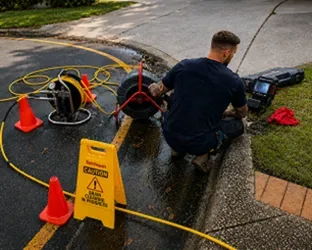
Not on a one-off. If a drain has blocked twice in the same spot, if you are about to pay for a repair, or if you are buying an older Parramatta home, seeing the pipe is the difference between clearing a symptom and knowing what to fix.
It also settles the boundary question. Where a blockage sits near the property line, footage of its actual position decides whether it is yours or Sydney Water's, which an opinion cannot. Our guide to whether a blocked sewer is Sydney Water's pipe or yours covers where that line falls, and how to claim back a plumber's bill when the fault is in the main.
A smell is worth a camera for the same reason. A drain that has cracked a joint leaks sewer air long before it leaks anything you can see, so if a bathroom has started to smell and pouring water down every trap has not fixed it, that is the fault we are looking for. Our guide on why a bathroom smells like sewage covers what to rule out first.
Relining, when digging the pipe up is the wrong answer
Once the camera has shown a cracked or root-opened section, there are two ways to fix it. Dig the pipe out and replace it, or reline it, which means curing a resin sleeve inside the existing pipe so you end up with a new pipe formed within the old one. No trench, and the line is back in service the same day in most cases.
Around Parramatta that choice comes up more than it does in a newer suburb, because the pipe that fails here is usually short-length earthenware running under something you would rather not lose. A concrete driveway in Harris Park, a paved courtyard, an established garden, or the roots of the very tree that caused the problem and that you would prefer to keep. Relining repairs the line and leaves the surface above it alone.
It is not always the right call. A pipe that has properly collapsed, or one that has dropped far enough out of alignment that a sleeve cannot seat, has to come up. That is a judgement made off the footage rather than over the phone, and if digging is genuinely the cheaper and better repair we will say so. Relining is quoted per metre once we know the length, the diameter and how we get to it, so the figure comes after the camera, not before.