A bathroom that smells like sewage is telling you something specific, and in almost every case it is the same thing: somewhere in that room, a drain has lost the plug of water that seals it. That plug is the only barrier between your bathroom and the sewer. It is not thick, it is not clever, and it disappears quietly.
The good news is that the most common cause costs nothing to fix and takes about two minutes. The rest of this walks through how to find out whether yours is that easy one, what to do if it is not, and why the smell tends to show up around Parramatta at this exact time of year.
Nine times out of ten a sewer smell in a bathroom is a dried out trap. Every drain is sealed by water sitting in a bend, the National Construction Code only asks for 25 mm of it in an ordinary room, and it evaporates when the fixture is not used. Pour water down everything, wait a day, and see if the smell goes. If it comes back within a week, or it is in more than one room, the seal is being pulled out rather than drying out, and that is a venting or drainage fault.
- Work out whether it is one room or the whole house
- Run every tap, shower and floor waste for a minute
- Pour a bucket of water down anything you never use
- Check the toilet where it meets the floor
- Find the drains you have forgotten about
- Rule out the impostors before you call anyone
- If it comes back, get a licensed plumber to vent-test it
On this page
- One room, or the whole house?
- Run everything for a minute
- Pour water down what you never use
- Check the toilet at floor level
- The drains you have forgotten
- Rule out the impostors
- When to call a licensed plumber
- Why Parramatta bathrooms do this in spring
- The apartment problem: the vent you cannot reach
- Five things that make it worse
- Emergency, or can it wait?
- How to stop it coming back
1. Work out whether it is one room or the whole house
Before you touch anything, walk the place with your nose. This one question splits the problem in half and it costs you sixty seconds.
A smell in one room only, strongest at floor level, is almost always a local fixture: a trap in that room has emptied. A smell in two or more rooms, or one that comes and goes as somebody upstairs uses water, is a different animal. That is the drainage system itself failing to breathe properly, and no amount of pouring water will hold it.
There is a third possibility that matters more in Parramatta than in most suburbs. At the 2021 Census, 10,062 of the suburb's 14,220 private dwellings were flats, against 903 separate houses, and in the CBD and Westmead towers the bathrooms on every floor share one stack. A smell that arrives and leaves on somebody else's schedule, with nothing in your own bathroom to explain it, is usually the stack rather than your fixtures, and it is the building's problem before it is yours.
Get down near the floor and sniff around the floor waste grate, then the shower, then the basin, then the toilet where the pan meets the tiles. Sewer gas is not subtle when you get close to the source. If one of those is clearly worse than the others, you have your culprit and steps 2 and 3 will probably finish the job.
Sydney Water explains the chemistry on its own network: a bacterium found in wastewater produces hydrogen sulphide, the rotten egg gas, which fills the air space in the pipes. It is why the utility runs about 12,500 ventilation shafts across Sydney, the Blue Mountains and the Illawarra, roughly one every 400 metres of pipeline, to keep air moving through the system. Your house is connected to that same air space. The only thing keeping it out is water sitting in a bend.
2. Run every tap, shower and floor waste for a minute
Start at one end of the room and work across. Run the basin for a minute, run the shower for a minute, flush the toilet twice, and if there is a bath, fill it a few centimetres and pull the plug so a decent slug of water goes through.
The bath is worth doing properly rather than just running the tap. Under the NSW rules for floor wastes, a bath commonly drains through an untrapped waste pipe of at least DN 40 into a floor waste gully, which means the bath itself may have no trap of its own. Its seal is the gully in the floor. A dribble down the overflow will not refill that; a proper volume of water will.
Then go and do the laundry, and if you are in a flat, which in this suburb most people are, do it anyway. The same NSW wet-area requirements put a floor waste into those rooms too, and a laundry floor waste behind a machine that drains straight into a standpipe can go months without seeing a drop.
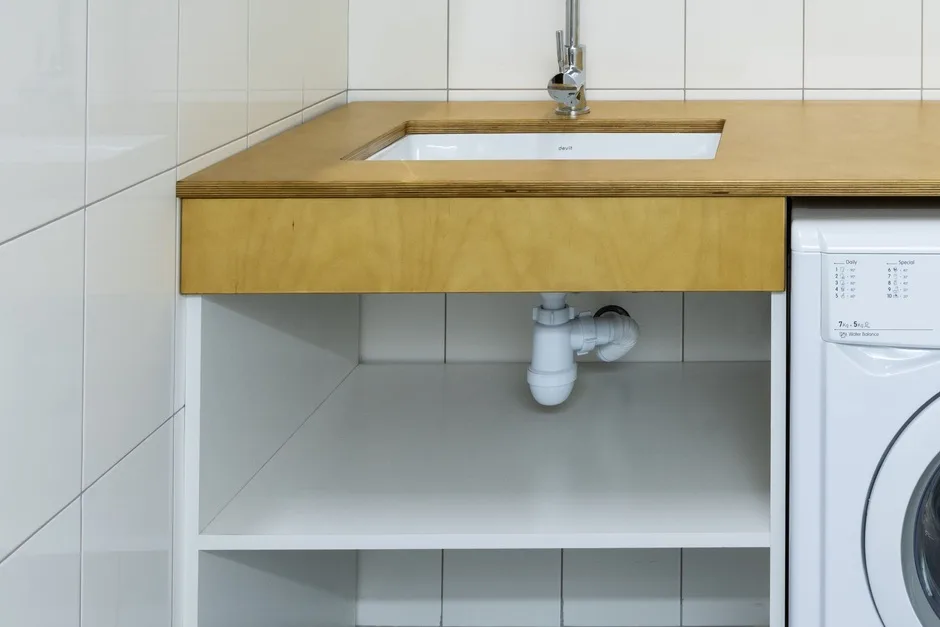
3. Pour a bucket of water down anything you never use
This is the step that fixes most of these, and the one most people skip because the drain in question does not feel like a drain. Take a bucket or a large jug and pour a few litres into the bathroom floor waste, the laundry floor waste, the laundry tub, and the ensuite or second bathroom nobody has used since visitors were last here.
The reason it works is that a trap seal is a much smaller thing than people imagine. The National Construction Code's performance requirement for sanitary plumbing asks the system to keep foul gas out of the building by holding a trap seal of 25 mm in an ordinary room, and 70 mm in a pressurised one. Twenty five millimetres of water in a warm, dry, unventilated bathroom does not last forever, and nothing tops it up automatically.
The month you are reading this in matters too. Parramatta's own weather station records September as its driest month of the year, averaging 50.0 mm of rain across sixty years of record. A seal that survived winter is at its most vulnerable right now.
Give it a day. If the smell is gone and stays gone, that was it, and the only maintenance you need is on your calendar rather than your plumbing.
Bleach or supermarket drain cleaner does nothing useful to a trap that has no water in it, because there is nothing there to disinfect. You are pouring a caustic product past the fitting you are trying to protect and into the drain line. Plain water refills a seal. A capful of cooking oil on top afterwards slows the evaporation in a drain you genuinely never use, which is a trick worth knowing before a long trip.
4. Check the toilet where it meets the floor
Kneel down and look at the join between the pan and the tiles, then run a dry tissue around the base. You are looking for damp, for a rocking pan when you push it gently side to side, and for a smell that gets noticeably stronger right at that seam.
Worth flagging, because most of what comes up when you search this is written for American houses: the fix you will read about is replacing a wax ring. Australian pans are generally not connected that way. Here the pan sits on a pan collar or connector with a rubber seal, and a leak at that joint is a plumber's job rather than a hardware-store part swap. If the pan moves when you push it, stop using it until someone has looked, because a shifting pan works that seal loose a little more every flush.
Where the pan sits changes what you are looking for. In the older raised-floor cottages around Harris Park and North Parramatta the pan is fixed to a timber floor that has been flexing for a century, and movement there is the usual cause. On the concrete slabs under most of the suburb's apartment stock the pan does not move much, so a smell at the base is more likely to be the seal itself or a failed silicone bead than a loose fixing.
Also lift the cistern lid and check that water is not trickling continuously into the pan. A constantly refilling cistern is a separate problem with its own cost, and we have written up what a running toilet actually adds to a Sydney Water bill.
Poured water everywhere and it still smells?
That points at the vent or the drain line, and it needs a camera and a smoke test rather than another bucket. We can be out today.
5. Find the drains you have forgotten about
Almost every house has more drains than the occupants can list. Go and find these four.
- The laundry floor waste. Often behind or under the machine, often covered by a mat, and in a lot of homes it has not seen water since the last time somebody mopped.
- The laundry tub. If the washing machine hose discharges into the tub rather than a standpipe, the tub gets used. If it does not, the tub trap dries out like any other.
- The overflow relief gully outside. The grate in the garden or the paving, usually near the laundry or bathroom wall. This one is designed to be the lowest opening on your drain so that a blockage surcharges outside rather than through your shower.
- The second bathroom. In a two-bathroom home, one of them is always the unloved one, and that is the one that smells.
The gully outside is worth a proper look while you are there. Building Commission NSW's current advisory note on overflow relief gullies sets two heights: the top of the riser must sit at least 150 mm below the lowest fixture connected to the drain, and at least 75 mm above the finished surface level. The Commission published that note precisely because it kept finding gullies that did not meet the clearances. Around Parramatta the second height is the one that slips, because reactive clay ground lifts and drops through the seasons and gardens get topped up, mulched and repaved over the decades until the grate is sitting in the dirt. If yours is sitting flush with the soil, buried under mulch, or has had a path poured up to it, it is both a smell path and a flood path, and that is worth fixing before summer storms.
6. Rule out the impostors before you call anyone
Not every bad smell in a bathroom is the sewer, and it is cheaper to eliminate the free explanations first.
- The bin, the mop, the towels. Obvious, frequently the answer, and mildly embarrassing to discover after a call-out fee.
- Biofilm in the overflow. The little slot near the top of a basin collects a sludge that smells genuinely awful. A bottle brush and hot water sorts it.
- Grout and silicone. Failed silicone at the shower base lets water sit under the tray, and what grows under there is not sewage but it smells close enough.
- Something in the roof or wall cavity. Rare, unmistakable once you have met it, and not a plumbing job.
One local note on the mould explanation, because the season argues against it right now. Parramatta North's mean 3pm relative humidity sits at 46 per cent in August and September, its lowest of the year, against 55 per cent averaged across the year. This is the driest air the suburb gets. That makes a damp, mouldy cause less likely in early spring than in February, and a dried out trap considerably more likely. In autumn the odds run the other way.
7. Call a licensed plumber if the smell comes back
If you have poured water down every drain in the place and the smell returns within a week, the seal is not evaporating, it is being pulled out. That is a venting fault, and it needs equipment rather than persistence: a smoke test to find where sewer air is escaping, and usually a camera down the drain line to see whether the line itself is broken or blocked.
Use someone licensed and ask for the number. In NSW you need a licence or certificate to do any plumbing, draining or gasfitting work regardless of the cost of the work, and the penalty for unlicensed work runs to $22,000 for an individual and $110,000 for a company. Ours is 368473C and it goes on every quote.
Worth a small note of local trivia that is also a useful sanity check: the NSW technical note that governs where these vents may and may not go is issued by the Plumbing Industry Advisory Service out of Parramatta. The rules for your bathroom are written a few streets away, they are public, and a plumber who knows them will tell you which one your bathroom is breaking.
8. Why Parramatta bathrooms do this, and why you notice in spring
There are two reasons this suburb produces more of these calls than the coast does, and one of them is simply the weather.
Parramatta is drier than the rest of Sydney. The Bureau of Meteorology's Parramatta North station has sixty years of record and averages 977 mm of rain a year. The Observatory Hill station in the city averages 1,211 mm, and Sydney Airport 1,100 mm. September is Parramatta North's driest month at 50.0 mm across an average of 5.8 rain days, and afternoon humidity there bottoms out at 46 per cent in August and September against 51 per cent at both of the coastal stations in the same month. None of that is dramatic on its own. It is exactly enough to be the difference between a rarely used trap that holds its 25 mm through spring and one that does not.
The ground moves, and the drains move with it. Much of Parramatta sits on the Cumberland Plain, where Wianamatta shale weathers into a clay soil recognised as reactive with appreciable shrink-swell capacity. It swells when it is wet and shrinks back when it dries, and it does that hardest in the swing between a wet winter and a dry spring. Buried pipe does not enjoy being lifted and dropped. Soil movement around a drain breaks the pipe or disrupts the joint connections, and a drain with a cracked joint leaks air long before it leaks anything you can see. That is the version of this problem that pouring water will never fix.
The older parts of Parramatta add a third layer, because plenty of the pre-1970s housing in Harris Park, North Parramatta and Granville still drains through original earthenware with mortared joints. Clay pipe in reactive clay ground is a combination that opens up joints, lets roots in, and vents sewer air into the garden and eventually into the house. When that is what we find, relining the line from the inside is usually less brutal than digging up a heritage-era garden to replace it.
9. The apartment problem: the vent you are not allowed to reach
This is where Parramatta stops looking like anywhere else. At the 2021 Census, 85.6 per cent of the suburb's occupied private dwellings were flats or apartments, 10,062 of them, against 903 separate houses. Almost nobody here has a vent pipe going up through their own roof.
In a unit, the air balance is handled by the building's stack and, very often, by an air admittance valve tucked into a wall cavity. NSW Fair Trading's technical note 4/2013 describes an air admittance valve as an alternative to an open vent pipe extending above the roof line, and sets out where one is allowed. Two of its rules matter to a resident:
- An air admittance valve may be used as a stack vent only where the stack does not extend through 10 or more floor levels. Parramatta has a lot of buildings well past that. 180 George Street, finished in 2023, runs to 66 floors across its two towers. Those stacks have to be vented to atmosphere.
- The valve has to be accessible for service, repair or replacement, allow adequate air to enter, and be given ventilation openings when it sits in a wall space. It also has to be installed upright within five degrees of vertical and protected from insect entry.
And here is the part that turns a rule into a smell. Building Commission NSW's advisory note 18/2022 reports that during audits of Class 2 buildings, which is what an apartment block is, the accessibility requirements for air admittance valves were frequently found to be non-compliant: valves installed inside walls with no access panel, cover or door, and walls then waterproofed, tiled and fire-rated over the top with no access provision at all. A valve that has stuck open behind a tiled wall will smell, will keep smelling, and cannot be replaced without opening the wall. If you live in a Parramatta flat, that is a realistic explanation for a smell that no amount of water will shift, and it is a conversation with the owners corporation as much as with a plumber.
10. Five things that make a sewer smell worse
- Sealing or taping over the floor waste grate. It hides the smell for a day and blocks the fixture that is supposed to take water off your floor. The NSW floor waste requirements call for an accessible removable grate on a riser of at least DN 80 for a reason.
- Pouring bleach into a dry trap. No water, nothing to disinfect, and the caustic goes straight past the fitting into the drain line.
- Masking it and leaving it. An air freshener buys a week. If the cause is a cracked drain joint under reactive clay ground, that week is spent letting the crack get bigger.
- Ignoring a gurgle. A drain that gurgles is a drain telling you the air balance is wrong, and it is the same fault that empties trap seals. We have written that one up separately: what a gurgling toilet actually means.
- Tiling over the access panel during a bathroom renovation. This is the apartment-specific one, and in a suburb that is 85.6 per cent flats it is not a rare case. It is exactly the finding the Building Commission published about Class 2 buildings. If your block's bathroom refit sealed the air admittance valve into the wall, the next person to need it has to break the waterproofing to get at it.
11. When it is an emergency, and when it can wait
Most sewer smells are not emergencies, and we would rather say so than sell you an after-hours call-out for a dry floor waste.
Call straight away if waste water is actually coming up anywhere, if the toilet has stopped working, if the overflow relief gully outside is running, or if the smell is strong enough to be unpleasant to be in the room with rather than merely noticeable. Those are drainage failures in progress, not ventilation quirks.
Ring Sydney Water on 13 20 90 instead of a plumber if the signs point past your boundary. Sydney Water publishes them: an overflow visible beyond your property boundary, such as from a maintenance hole on public land; neighbours with the same problem; widespread flooding in your area; or a continuous overflow while you are not using water. Their own guidance is blunter than most: trust your nose, because a whiff of wastewater might be the first sign of something serious, and if you think the smell is coming from their pipes or one of their sites, treat it as an emergency. The line runs 24 hours. If your plumber does find the blockage is on their side, get the job number from them on the day, because a reimbursement claim needs it and takes up to eight weeks.
It can wait until a normal appointment if the smell is confined to one room, everything drains normally, nothing is backing up, and pouring water made a difference even temporarily. Book it in, and in the meantime keep the trap topped up.
If you rent, and in a suburb of 10,062 flats plenty of people do, one honest word: a smell on its own is not on the NSW list of urgent repairs, which covers things like a blocked or broken toilet, a burst water service, a gas leak and a serious roof leak. Report it in writing as a normal repair, and if the toilet stops working or waste starts coming up, say so, because at that point it is urgent and it is treated differently.
12. How to stop it coming back
- Put a reminder in your phone for the start of spring. August and September are the driest, lowest-humidity months Parramatta gets, and that is when a rarely used trap is most likely to give up. A bucket of water down every seldom-used drain, once a month through the dry half of the year, is the entire maintenance program.
- Before a holiday, do the rounds. Fill every trap and put a splash of cooking oil on top of the ones you will not be back to for a fortnight. It floats and slows the evaporation.
- Get the gully height checked. If your overflow relief gully is not sitting clear of the ground by the required margin, get it raised. It is a small job and it is the thing standing between a sewer blockage and your floor.
- If you are renovating a unit bathroom, insist on the access panel. Ask, before the tiler starts, where the air admittance valve is and how someone gets to it afterwards.
- Do not ignore a slow drain. A drain that empties slowly is on its way to being a drain that blocks, and both of them push sewer air into the room. If it is already sluggish, our blocked drain page covers what we do about it and what it costs.
- A sewer smell means a water seal has gone. The Code only asks for 25 mm of water in an ordinary room, and nothing refills it but you.
- Pour water down every drain in the house, including the ones you forgot you had, then wait a day.
- Parramatta is genuinely drier than coastal Sydney, and August and September are its driest, lowest-humidity months, which is why traps give up now.
- If it comes back within a week, or it is in two rooms, it is venting or the drain line, not evaporation.
- In a flat, an air admittance valve sealed behind a tiled wall is a real and documented cause, and it belongs to the building as much as to you.
- Waste coming up, or a toilet that has stopped, is the point where it stops being a smell and starts being an emergency.
Bathroom smell FAQs
Why has the smell only started now that it is spring?
Because this is the driest, thirstiest stretch of the Parramatta year. The Bureau of Meteorology's Parramatta North station averages 50.0 mm of rain in September across sixty years of record, its lowest month alongside July, on an average of 5.8 rain days, and mean 3pm humidity bottoms out at 46 per cent in August and September. Dry air pulls water out of an unused trap faster than damp air does, so a floor waste that held its seal all through a wet autumn gives up in the first warm, dry fortnight of spring.
The bathroom I never use is the one that smells. Why?
That is the classic case, and it is not a coincidence. Every drain in the house is sealed by nothing more than a plug of water sitting in a bend. The National Construction Code's number for an ordinary room is 25 mm of water depth, which is not much, and nothing tops it up except you using the fixture. A spare bathroom or a second ensuite that nobody has run for a month has quietly evaporated its own seal, and the drain is then an open pipe between the sewer and your hallway.
My flat has no vent pipe through the roof. Where does the air go?
Into an air admittance valve, most likely, which NSW Fair Trading's technical note 4/2013 describes as an alternative to an open vent pipe extending above the roof line. There is a catch worth knowing in a suburb built like this one: that note only permits an air admittance valve as a stack vent where the stack does not run through 10 or more floor levels. In a tower like 180 George Street, which tops out at 66 floors, the stack has to vent to atmosphere the old-fashioned way, so a smell there is a different problem from a smell in a four-storey walk-up.
Is the smell coming from Sydney Water's pipes or from mine?
Sydney Water's own line is to trust your nose, because a whiff of wastewater might be the first sign of something serious. The signs it is theirs rather than yours are published: an overflow visible beyond your property boundary such as from a maintenance hole on public land, neighbours with the same problem, widespread flooding locally, or a continuous overflow while you are not using any water. Any of those, or a smell you think is coming from their pipes or one of their sites, is a call to 13 20 90, which runs 24 hours.
I rent in Parramatta. Is a sewer smell an urgent repair?
Usually not on its own, and it is worth knowing that before you argue about it. The NSW list of urgent repairs covers a blocked or broken toilet, a burst water service, a serious roof leak, a gas leak and a fault that makes the property unsafe or insecure. A smell by itself is not on that list, so it is an ordinary repair request rather than a same-day one. If the toilet has stopped working, or waste is actually coming up anywhere, that is a different conversation and it is urgent.
There is a grate in the garden near the laundry wall and it stinks. What is that?
That is almost certainly your overflow relief gully, and it is doing its job by being the lowest opening on the drain, so that a blockage surcharges into the garden instead of through your shower. Building Commission NSW's advisory note 1/2026 sets its heights: at least 150 mm below the lowest fixture connected to the drain, and at least 75 mm above the finished surface level. Around here that second one matters, because reactive clay ground moves and gardens get topped up and repaved over the years, and a gully that has ended up level with the soil is both a smell path and a flood risk.