A toilet that will not stop running is the cheapest plumbing problem to fix and one of the most expensive to ignore. No flood, no smell, often no noise, just a cistern quietly passing water into the pan and a meter turning over in the front lawn. Sydney Water puts the worst case at 260 litres a day, which at this year's rate is over eighty dollars on a single quarterly bill.
Here is how to prove it is leaking, work out which of the two valves has gone, stop the loss in about a minute, and cost it properly. If you already know it needs a plumber, the team here in Parramatta can take it from there.
Put a piece of dry toilet paper at the back of the bowl. If it is wet before the next flush, the cistern is leaking, and Sydney Water says that can be up to 260 litres a day, or $81.57 on a quarterly bill at the 2026-27 rate of $3.41 a kilolitre. Shut the small isolation tap under the cistern to stop the cost today, then get the inlet valve or outlet seal replaced.
- Dry paper at the back of the bowl. Wet before the next flush means a leak
- Lift the lid: water at the overflow tube points at the inlet valve
- Level dropping with the supply off points at the outlet seal
- Turn the isolation tap under the cistern clockwise to stop the loss
- Book a licensed plumber. There is no NSW DIY exemption for cistern work
On this page
- Prove it is actually leaking
- Lift the lid and look at the water level
- Work out which valve has failed
- Shut the isolation tap at the cistern
- Read your water meter to size the leak
- Find out whose bill this actually lands on
- Get the valve replaced by a licensed plumber
- What a running toilet costs on a Parramatta bill
- Why cisterns fail this way around here
- Five things that make it worse
- When it is urgent, and when it can genuinely wait
- How to keep it from happening again
1. Prove it is actually leaking
Start here, because a cistern can be losing water without a sound. Sydney Water's own test needs nothing but the roll beside you: place a small piece of dry toilet paper at the back of the toilet bowl and check that it stays dry until the next flush. If the paper is wet, water is passing from the cistern into the pan.
Sydney Water put the rule plainly: toilet cisterns should not release any water between flushes. Not a trickle, not a film down the back of the porcelain. Any movement at all is a leak, and a silent one costs exactly the same as a noisy one.
Skip the food colouring trick. The paper test proves the same thing in ten seconds and stains nothing. It also matters more in Parramatta than in most suburbs, because the meter test further down this page needs a meter you can actually walk out to, and 85.6% of homes here are flats or apartments. For most of Parramatta, that piece of paper is the whole diagnostic kit.
2. Lift the lid and look at the water level
Take the lid off and set it flat on the floor, not balanced on the seat. You are looking for one thing first: where the water sits relative to the overflow tube, the open pipe standing up in the middle.
If the water is sitting at or above the top of that tube, the cistern is filling too high and pouring straight down the overflow into the pan, forever. That is the loudest and most common version of a running toilet, and it points at the inlet valve or its float setting rather than anything at the bottom of the cistern.
If the water sits well below the overflow and the pan is still wetting your paper, the leak is going out the bottom instead, past the outlet valve seal.
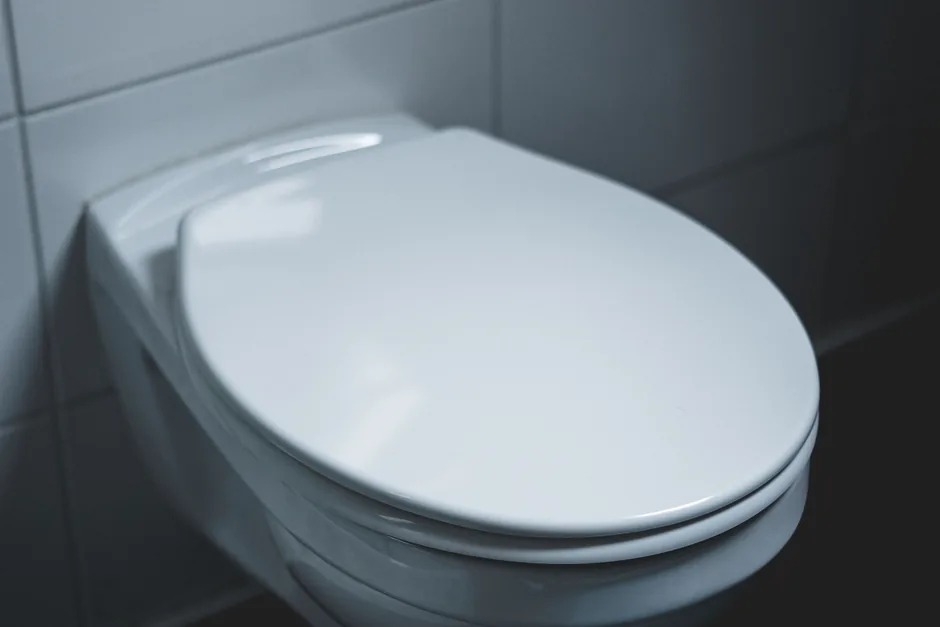
If you have a wall-hung pan and a flush plate flat against the tiles, there is no lid to lift. The cistern is buried in the wall behind that plate, and the plate is the access panel. It comes off, but it is fiddly, and a plumber can do it without cracking a tile.
In a Parramatta apartment that detail has a second edge to it. The flush plate is your access point and it has to be, because under the NSW common property memorandum the pipes inside a common property wall, floor or ceiling belong to the owners corporation. Opening the tiled wall beside the pan to get at a cistern is not a decision a lot owner gets to make alone.
3. Work out which valve has failed
There are only two valves in a cistern and each fails in its own way, so five minutes of looking saves you guessing at the parts counter.
The inlet valve is the one the water supply feeds into, usually on one side, with a float attached. Its job is to shut the water off when the cistern is full. When it fails, the cistern keeps taking water and dumping the excess down the overflow. Push the float down gently by hand: if the water stops, the valve is fine and the float or its adjustment is the problem. If water keeps coming, the valve itself is done.
The outlet valve sits in the middle at the bottom, under the flush buttons, and it is the rubber seal there that lets water bleed into the pan. To test it, turn the water off at the cistern (next step), mark the water level with a pencil, and come back in twenty minutes. If the level has dropped with the supply off, water is escaping downward and the outlet seal is the culprit.
Neither is meant to last the life of the toilet. They are rubber and plastic sitting in water under constant pressure, and the pressure is not gentle: Sydney Water's average across its network is 52 metres of head, and low-lying properties get more than that. A cistern that has been rebuilt once before is not a lemon, it is a toilet that has been used.
4. Shut the isolation tap at the cistern
Look under the cistern where the supply pipe comes out of the wall or floor. There is almost always a small chrome tap there, often with a screwdriver slot rather than a handle. Turn it clockwise until it stops and the cistern stops refilling.
That does not fix anything, but it stops the meter turning while you organise a repair, and if the fault is the inlet valve it stops the overflow immediately. You can flush the toilet by tipping a bucket of water into the pan in the meantime, which is not elegant but works perfectly.
If there is no isolation tap, or it is seized, do not force it, because older ones shear. In a house you can fall back on the main tap at the front boundary. In an apartment the equivalent is the main stopcock to your unit, which the NSW common property memorandum puts on the owners corporation's side of the list rather than yours.
5. Read your water meter to size the leak
This is the step that turns an annoyance into a number. Sydney Water's method: turn off all taps and appliances that use water, including drip systems, dishwashers and washing machines. Find your meter, leaving the meter tap turned on. Note the numbers on the dial. Do not use any water for at least the next hour. Then check the last numbers again. If they have changed, you have a leak.
On most Parramatta houses the meter is in a small box set into the lawn or garden bed near the front boundary, the same box you would reach for in a burst. In a Parramatta apartment you may have no meter of your own at all, which is its own problem and the subject of the next step.
Do the test twice, once with the cistern isolation tap open and once with it shut. If the dial moves on the first run and stops dead on the second, you have just proved the toilet is the whole leak. If it keeps moving with the toilet isolated, something else on the property is losing water too, and that is worth chasing properly before the next bill.
Cistern still running?
Isolation tap off and you want it sorted properly? A licensed local plumber can be out to you.
6. Find out whose bill this actually lands on
In a freestanding Parramatta house this question is easy: the water is metered to you and you pay for every litre. In an apartment it is genuinely not obvious, and the answer decides whether anyone will ever notice.
Individual metering of units only became a condition of connecting to Sydney Water's system for developments lodging a Section 73 Compliance Certificate application after 1 September 2014. Before that date it was not required. So a Parramatta block put up in the last decade is very likely to meter each unit separately, and an older walk-up is very likely to sit on one master meter for the whole property.
That matters more here than almost anywhere. The 2021 Census counted 14,220 private dwellings in Parramatta, and 85.6% of them are flats or apartments against 7.7% separate houses. If your building is on one meter, your running toilet does not appear on a bill with your name on it. It lands in the owners corporation's quarterly bill, gets spread across every lot through the levies, and can run for years because nobody is looking at a number that points at your bathroom.
Which side of the line you are on takes one check: do you receive a Sydney Water bill for your unit, or does water come out of your levies? That is the whole test.
7. Get the valve replaced by a licensed plumber
In NSW you need a licence or certificate to do any plumbing, draining or gasfitting work, regardless of the cost of the work or whether the work is residential, commercial or industrial. There is no dollar threshold and no minor-works carve-out for cistern internals. Unlicensed work carries fines of up to $22,000 for an individual, and it is the kind of thing an insurer looks for when a claim involves water.
The repair itself is usually small. An inlet valve or an outlet seal is a common part and a short visit, and a plumber should pressure-test the cistern afterwards rather than watching it fill once and leaving. If the pan is a single-flush relic, ask for the cost of replacing the suite as well, because over three years it can come out lower than feeding the leak. Ask for the licence number on the quote too. Ours is 368473C.
8. What a running toilet costs on a Parramatta bill
Here is the arithmetic, using Sydney Water's own figures rather than a guess. Sydney Water says a leaking toilet can waste as much as 260 litres of water every day. From 1 July 2026 to 30 June 2027 the residential drinking water usage charge is $3.41 a kilolitre.
Sydney Water bills quarterly, and their own quarter lengths are 92 days for the July and October bills, 90 for January and 91 for April. At the full 260 litres a day, on a 92 day quarter:
- 23.92 kilolitres of water, which is $81.57 added to a single quarterly bill
- $323.61 a year if it runs all four quarters, for water nobody drank, washed in or watered a garden with
- A quarter of that leak, a slow 65 litres a day, is still $20.39 a quarter and about $81 a year
For scale: Sydney Water's typical house uses 50 kilolitres in a 92 day quarter, and the whole bill for water and wastewater services at that usage is $387.03. A toilet leaking at the headline rate adds another 23.92 kilolitres on top, so you are paying for close to half a household again out of one cistern.
The drinking water charge rises to $3.84 a kilolitre if Greater Sydney dam levels drop below 60%, and stays there until they rise back above 70%. And the wastewater charge on a home bill is a flat quarterly service fee, so none of this shows up there. The entire cost of a running toilet lands in the one usage line, which is exactly the line people skim past.
Another way to feel it: the WELS star rating for toilets is built on a person's expected daily use of four half flushes and one full flush. On a four star 4.5 litre and 3 litre dual flush, that is 16.5 litres a day, per person. A cistern leaking 260 litres a day is running through roughly sixteen people's worth of toilet water, out of an empty bathroom, every single day.
9. Why cisterns fail this way around here
Nothing about a Parramatta cistern is exotic, but two local realities shape how they fail, and one very common piece of advice is simply wrong for this city.
It is not scale, and it never was. Sydney's supply is soft, in the order of 43 mg/L across the network and roughly 50 mg/L out of Prospect, both comfortably under the 60 mg/L line where water starts being called hard. The overseas advice about descaling a fill valve does not apply here. When a Parramatta inlet valve stops sealing, it is the rubber diaphragm perishing, or a fragment of grit sitting on the seat, not a crust of limescale.
Pressure does the wearing. Sydney Water says most Sydney properties receive water pressure of between 15 and 65 metres head, that the average across its whole area of operations is 52 metres, and that some customers receive above 100 metres head. Because water is fed by gravity from reservoirs at the high points of each supply zone, properties in low areas receive higher pressure and properties up high receive less. A cistern inlet valve is a small rubber seal holding back whatever pressure is on that line, all day, for years. On a high pressure service it is working harder than the same valve two streets uphill, and a pressure limiting valve is what takes that strain off every fitting in the house at once.
Concealed cisterns hide the evidence. A close-coupled cistern announces a problem: you hear it, you see the lid, you can look inside in ten seconds. An in-wall cistern behind a flush plate does none of that. The first sign is a bill, or a strata bill, which is why these ones tend to run the longest.
10. Five things that make it worse
- Turning the water down instead of off. Half closing the isolation tap slows the refill and quietens the noise, which feels like progress and is really just a quieter leak on the same meter.
- Bending the float arm to lower the level. It is the classic bodge and it works for a fortnight. If the valve is not sealing, moving the float only changes where it fails to seal.
- Dropping a cleaning block in the cistern. Those blocks sit against the outlet seal and the rubber components and are a common way to turn a fine cistern into a leaking one. In the pan, fine. In the cistern, no.
- Waiting for the bill to confirm it. By the time a Sydney Water bill arrives you have already paid for most of a quarter of it, and in an older Parramatta block on a master meter the bill will never point at you at all.
- Assuming the strata will handle it. The NSW common property memorandum puts the toilet bowl and cistern squarely on the lot owner's side of the list. The owners corporation's plumbing items are the sewer and floor drain in common property, pipes inside common property walls, floors and ceilings, and the main stopcock to the unit. Your cistern is yours.
11. When it is urgent, and when it can genuinely wait
Most running toilets are not an emergency. If the cistern is bleeding quietly into the pan, the isolation tap works, and you have shut it off, you have stopped the cost and you can book a normal appointment. Nobody needs to pay after-hours rates for a worn outlet seal.
It is also worth being sure of what you are hearing. A hiss or a trickle from inside the cistern is this problem. A gurgle or a bubble from the pan itself is a different one entirely, and that one is the drain below struggling to breathe rather than a valve failing to seal.
Call sooner if water is escaping the cistern rather than staying inside it, over the rim or out from under the flush plate, because that is a leak into your floor and, in an apartment, into the ceiling below. Call sooner if the isolation tap is seized or missing and you cannot stop the flow, or if it is the only toilet in the property.
One thing worth knowing before you make the call: this is exactly the leak Sydney Water's safety net does not catch. Their hidden leak allowance gives a goodwill credit for 50% of the water usage charge on the most impacted quarter, once every five years per property, but they explicitly cannot offer it for visible leaks, and their exclusion list names taps, toilet cisterns, dishwashers and washing machines. A running cistern is counted as visible whether or not you ever noticed it. There is no credit coming, which is the whole argument for fixing it this week rather than next quarter.
12. How to keep it from happening again
- Run the paper test once a quarter, on every toilet in the property. It takes ten seconds and it is the only way to catch a silent one early.
- Look at the usage line on your bill, not the total. The total moves with service charges. The kilolitres are what tells you something changed.
- Replace both valves together when one goes. They are the same age and have sat in the same water, and a second call-out costs more than the second part.
- Ask about a pressure limiting valve if your home does not have one. It is the single fitting that reduces wear on every valve, seal and joint in the house at once.
- If you are in a Parramatta block on one meter, raise it at the next owners corporation meeting. Sydney Water's WaterFix Strata program is built for exactly this: a flat $44 per unit that covers project management, labour and minor repairs, and the repair of tap and toilet leaks across the whole building.
- Sydney Water's test is a piece of dry toilet paper at the back of the bowl. If it is wet before the next flush, the cistern is leaking.
- At their 260 litres a day figure and the 2026-27 rate of $3.41 a kilolitre, that is $81.57 on one quarterly bill and $323.61 over a year.
- Water level at or above the overflow tube points at the inlet valve. Level dropping with the supply off points at the outlet seal.
- In a Parramatta block metered before September 2014 the leak never reaches a bill with your name on it, it reaches everyone's levies.
- Sydney Water's hidden leak allowance explicitly excludes toilet cisterns, so no credit is coming. Shut the isolation tap and book the repair.
Running toilet FAQs
I own a Parramatta apartment and never see a water bill. Who is paying for my running toilet?
Almost certainly everyone in the building, including you, through the levies. Individual metering of units only became a condition of connecting to Sydney Water's system for developments that lodged a Section 73 Compliance Certificate application after 1 September 2014, so older Parramatta blocks are commonly on one master meter for the whole property. In that case the water your cistern loses lands on the owners corporation's quarterly bill and is shared across every lot, which is why these leaks run for years. Check whether a Sydney Water bill arrives in your name or whether water comes out of your levies.
Can I claim Sydney Water's hidden leak allowance for a leaking cistern?
No. The hidden leak allowance is a goodwill credit for 50% of the water usage charge on the most impacted quarter, one per property every five years, but Sydney Water cannot offer it for visible leaks, and their exclusions specifically name taps, toilet cisterns, dishwashers and washing machines. A running toilet is treated as visible whether or not anybody noticed it. The allowance is there for the concealed leaks under a slab or in the ground, so this one is entirely on you to catch.
Is Parramatta's water hard? Is that what has wrecked the cistern valve?
No, and this is the piece of advice most worth ignoring. Sydney's supply is soft, in the order of 43 mg/L across the network and roughly 50 mg/L out of Prospect, both under the 60 mg/L threshold where water is considered hard. Nothing is scaling up in your cistern. When an inlet valve here stops sealing it is the rubber perishing with age or a fragment of grit on the seat, and the fix is a new valve rather than a descaler.
Can I replace the cistern valve myself in NSW?
No. In NSW you need a licence or certificate to do any plumbing, draining or gasfitting work, regardless of the cost of the work or whether the work is residential, commercial or industrial. There is no minor-works exemption covering cistern internals, penalties run to $22,000 for an individual, and unlicensed work is the sort of thing an insurer looks for if a water claim follows. Shutting the isolation tap yourself is fine. Changing the valve is not.
Our whole block is on one water meter. Is that even allowed?
Yes, if the building predates the requirement. Individual metering became a condition of connection only for developments lodging a Section 73 Compliance Certificate application after 1 September 2014, so plenty of Parramatta buildings were never required to have it. An owners corporation can choose to retrofit individual meters, and it has to be done to Sydney Water's requirements for multi-level metering. Where individual meters do exist, common water use such as centralised hot water, pools, gardens and fire hose reels still lands on the owners corporation's bill.
The building's water bill has jumped and nobody knows which unit is leaking. What now?
This is common in a master-metered block, because a single leaking cistern anywhere in the building looks identical on the bill to slightly heavier use everywhere. Sydney Water runs a program for it: WaterFix Strata, aimed at stratas on a common water meter, at a flat $44 per unit that covers project management, labour and minor repairs, and the repair of tap and toilet leaks. Their own case study on a 292 apartment building recorded 602 toilet and tap leak repairs, more than two per apartment, and savings of around $17,000 a quarter. If your levies have moved and nobody can explain it, that is the conversation to have with the strata committee.