A water bill that jumps for no obvious reason comes down to one of three things: the price went up, the household used more, or water is escaping somewhere you cannot see. You can tell which one you have in about an hour, with the bill in one hand and the meter at your front fence in the other. Around Parramatta there is a fourth possibility worth ruling out early, because most people here live in a unit or rent, and that changes whose bill it even is.
Work through the steps below in order. The first three cost nothing and settle most cases. If the meter is still turning with every tap off, the rest of the guide covers finding the leak, getting money back from Sydney Water, and why leaks in this part of Sydney so often stay hidden.
Check whether the usage line or the fixed charges went up, because Sydney Water's prices rose on 1 July 2026 and usage is now $3.41 a kilolitre. Then compare your average daily use with a water-efficient home your size, and run the one-hour meter test. If the meter moves with everything off, you have a leak, and a hidden one repaired by a licensed plumber can earn a credit on your bill.
- Find which line on the bill actually went up
- Compare your daily litres with Sydney Water's targets
- Check the meter reading against the bill
- Turn everything off and watch the meter for an hour
- If it moves, find the leak, fix it, and claim the allowance
On this page
1. Find out which part of the bill went up
Put this bill next to the one from the same time last year and compare the lines one at a time, not the total. A Sydney Water bill for a home is fixed charges for being connected to water, wastewater and stormwater, plus a usage charge for the water you actually used. Only the usage line moves when you use more or when something leaks.
Part of a bigger total right now is simply price. From 1 July 2026 the drinking water usage charge went from $3.17 to $3.41 a kilolitre, and the wastewater service charge went from $174.40 to $189.88 a quarter. The water service charge for a metered home actually fell, from $29.73 to $26.65. Sydney Water's own example of a typical house using 50 kilolitres in a 92 day quarter is now $387.03. Run the same 50 kilolitres through last year's prices and it comes to $362.63, so the same household using exactly the same water pays about $24 a quarter more without changing a thing.
If the usage charge is where the jump is, look at the kilolitres, not the dollars. A usage line that rose about 8% with the same kilolitres is the new price. A usage line that rose 40% because the kilolitres did is the thing worth chasing.
One more line to check while you are there: the usage rate itself. Sydney Water has a higher drought rate of $3.84 a kilolitre that only applies when Greater Sydney's dams drop below 60%. If your bill shows $3.41, you are on the normal rate.
2. Compare your daily use against a water-efficient home your size
Find your average daily usage in litres on the bill and compare it with Sydney Water's targets for a water-efficient household the same size as yours. The targets are broken down by season, number of people and block size, and that comparison tells you far more than the dollar figure does.
For a bill covering August to October, Sydney Water's target for a small block under 500 square metres is 189 litres a day for one person, 340 for two, 436 for three and 501 for four. Summer targets run a little higher because gardens get watered. Their efficient household is not a monk's household either: it waters outside two or three times a week, takes a 4.5 minute shower each day, runs a front-loader and fixes any obvious leaks.
If you are close to the target, the bill is probably price and habit rather than a fault. If you are well over it and nothing changed at home, no visitors, no new pool, no new garden, keep going. Sydney Water's own leak advice starts from exactly that pattern: a bill that went up even though you have not changed the way you use water.
3. Read the meter and check it against the bill
Go out to the meter and compare the black numbers with the reading printed on the bill. On most Parramatta houses the meter sits just inside the front boundary, usually in a small box in the lawn or garden bed near the street. Mechanical meters are read once every three months, so a misread or an estimate can land a big number on one bill and a small one on the next.
The black numbers are whole kilolitres, the red numbers are litres. The common Elster meter has four black numbers and three red ones; an Itron has five black, three red and a small clock-face dial. If the black figure at your front fence is lower than the reading on a bill that has already been issued, the bill is wrong. Call Sydney Water on 13 20 92 and they will adjust it.
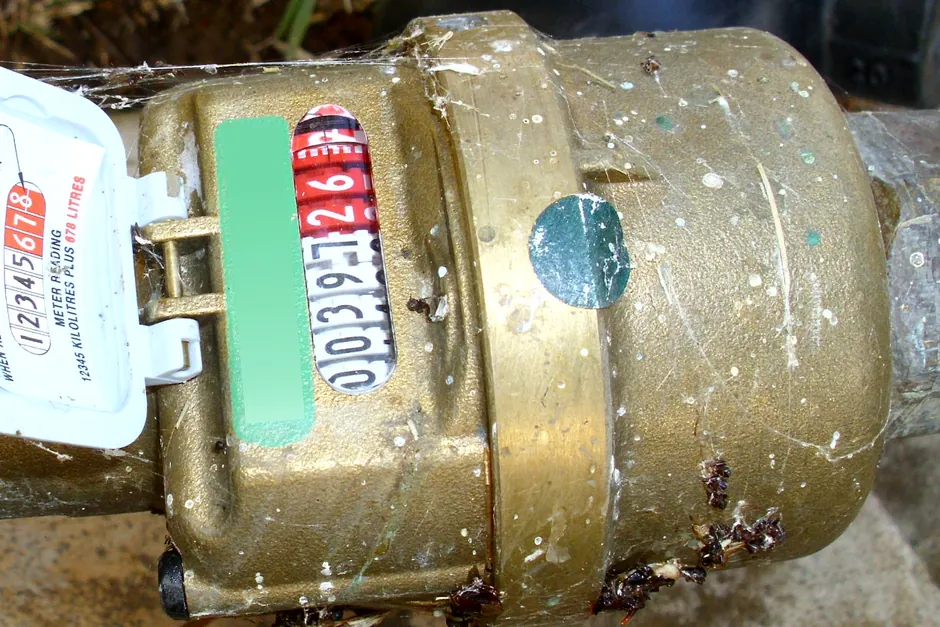

If you have one of Sydney Water's new smart meters, you will see a digital display in kilolitres instead of dials. Those send a reading every hour rather than once a quarter, and if you register for My Account, Sydney Water can text or email you when your overnight use looks too high. That alert is free, and it is the single best leak warning a household can have.
4. Turn everything off and watch the meter for an hour
This is the test that settles it. Turn off every tap and every appliance that uses water, including the dishwasher, the washing machine and any garden drip system, but leave the tap at the meter itself on. Write down the numbers on the dial, including the red ones. Use no water at all for at least an hour, then read it again.
If the red numbers have moved, water is leaving the pipes on your side of the meter. The bigger the change, the bigger the leak. Sydney Water's method says an hour, and it is worth doing it properly rather than glancing at it for a minute: a slow leak in the ground can take a while to show up in the red digits.
If an hour shows nothing but the bill says otherwise, read the meter last thing at night and again before anyone gets up. Eight hours of no use will show even a slow weep that an hour can miss.
5. Check the usual suspects before you assume it is underground
If the meter moved, start with the leaks you can find yourself, because they are the most common and the cheapest. Place a small piece of dry toilet paper at the back of each toilet bowl and see if it stays dry until the next flush. Sydney Water's rule is that a cistern should not release any water between flushes, and a leaking toilet can waste as much as 260 litres a day.
- Toilets. At the new price, 260 litres a day over a 92 day quarter is about $82 on one bill. We have a full guide to what a running toilet costs and how to stop it.
- Taps. A dripping tap can waste as much as 200 litres a day, which is about $63 a quarter. You are allowed to change a washer yourself in NSW, and our guide on what you can legally fix yourself sets out where that permission stops.
- The hot water system. Check the relief valve near the top of the tank when nobody has used hot water for a while. A small discharge while the tank is heating can be normal; a valve that runs constantly is not, and a hot water system that is quietly topping itself up all day shows on the meter like any other leak.
- Garden taps and irrigation. Disconnect hoses and drip lines that stay connected to a tap, then check the tap itself is not leaking.
- The lawn. Walk the line between the meter and the house. A patch of grass greener than the rest, or ground that stays damp in dry weather, can mean an underground pipe is leaking.
6. Get a hidden leak found and fixed by a licensed plumber
If every visible fitting checks out and the meter still moves, the leak is concealed: in the ground, under the slab or inside a wall. Book a licensed plumber with leak detection gear rather than digging to look. Acoustic listening and pipe location equipment finds the spot, so only that spot gets opened up.
Sydney Water runs its own service for this, WaterFix Concealed Leaks, and it is fair to tell you about it. It charges $450 for the first hour of investigation, $130 for each extra half hour, and $260 if the cause turns out to be an obvious leak or no leak at all, with repairs quoted separately. Their own case study shows why speed matters: a house that normally used 400 litres a day was found losing 17,280 litres a day through a burst tee on a garden tap line. At today's $3.41 a kilolitre, that leak would cost more than $5,400 over a 92 day quarter.
Whoever you use, two things matter for your money. The repair has to be done by a licensed plumber or qualified technician, and you need their invoice with their business name, ABN and licence number on it. Our leak detection and repair team works under licence 368473C and gives you the invoice and the detail you need to apply.
Meter moving with every tap off?
A licensed Parramatta plumber can locate the leak and give you the paperwork Sydney Water asks for.
7. Claim Sydney Water's hidden leak allowance
Once a hidden leak has been repaired, the property owner can ring Sydney Water on 13 20 92 and apply for the hidden leak allowance. It is a goodwill credit for 50% of the water usage charge on the most impacted quarter, and each property can have one every five years.
Have these ready: the property address, the date the leak was fixed, the meter serial number, a photo of the meter reading taken after the repair with the date it was read, and the plumber's invoice and details. You have to tell Sydney Water within a year of the repair. Take the meter photo the day the job is finished, because it is the piece people forget.
Know the exclusions before you count on the money. Sydney Water will not give the allowance for visible leaks, and their list includes taps, toilet cisterns, dishwashers, washing machines, and damp soil or consistently wet grass. You also have to have been unaware of the leak and have maintained the service. That is a real catch for the lawn test in step 5: a wet patch you noticed and left for months can count as visible. Call as soon as you see it.
8. In a Parramatta unit or rental, check whose bill it is
Most of the advice online assumes you own a house with a bill in your name. Parramatta is not that place. At the 2021 Census, 85.6% of occupied dwellings in the suburb of Parramatta were flats or apartments, against 21.7% across NSW, and 70.2% of households rented. That changes the answer more than anything else in this guide.
If you own a unit, look at when the building went in. Sydney Water only made individual unit meters a condition of connection for developments with Section 73 applications after 1 September 2014. Plenty of older Parramatta blocks are on one shared meter at the front, so there is no water bill in your name at all, and a leak in any unit lands on the owners corporation and gets shared through the levies. Even in newer buildings with their own meters, common use such as central hot water, pools, gardens and fire hose reels goes on the owners corporation bill. Sydney Water's WaterFix Strata program is built for the shared-meter case: buildings using more than 250 litres per bedroom per day can have toilets and taps checked and repaired across the complex for a flat $44 per unit.
If you rent, the bill goes to your landlord, not you. Under NSW rules your landlord can only pass on the water usage charge, never the fixed service charges, and only if the property is separately metered, meets the water efficiency measures, and you are shown the bill. Since 23 March 2025 those measures include dual-flush toilets of at least 3 stars, shower heads and kitchen and basin taps of no more than 9 litres a minute, and no leaking taps or toilets at the start of the tenancy. A shared-meter unit fails the first test. If a hidden leak is found and the owner gets the allowance, Sydney Water says the credit for water you paid for should be passed on to you. Report visible leaks like a dripping tap or a running toilet to the agent in writing, so there is a record of when the owner knew.
For the whole picture on shared pipes, stacks and who repairs what in a block, see our guide to strata plumbing and who pays.
9. Why leaks hide under Parramatta homes
Concealed leaks are not evenly spread across Sydney. A few things about this area make them more likely, and more likely to go unnoticed until the bill arrives.
The ground moves the pipes. Much of Parramatta sits on clay soils weathered from Wianamatta shale. Clay like this swells when it is wet and shrinks back when it dries, and across a run of wet spells and dry spells it lifts and drops the service pipe buried in it. That slowly works joints apart. A joint that has opened a fraction in the ground leaks steadily, day and night, with nothing to see from the house.
The pipes are old. Many homes in Harris Park, North Parramatta and Granville still have original galvanised steel water pipe. It corrodes from the inside out for decades before it finally weeps through, and when one section goes, the rest of the run is the same age.
The run from the meter can be long. On a house the meter is at the front boundary, so every metre of pipe between the street and the back of the house is yours. Older homes and semi-detached houses sometimes share a supply pipe with the property next door, which Sydney Water notes is a reason some homes do not have their own meter. If that is you, a leak on a shared line can turn up on someone else's bill or yours, and the meter test will not tell you which.
Units hide it differently. In a tower, the leak is more often a cistern or a mixer inside one of a hundred apartments than a pipe in the ground. On a shared meter that looks exactly like everybody using a little more, which is why it can run for years.
10. Five things that make a high water bill worse
- Waiting for the next bill to confirm it. Mechanical meters are read once a quarter, so by the time the second bill arrives you have paid for six months of the leak. The one-hour meter test gives you the answer today.
- Leaving a wet patch on the lawn. Beyond the water, consistently wet grass is on Sydney Water's list of visible leaks, so leaving it can cost you the allowance as well.
- Digging to look for it. A trench across the yard costs you twice, once to dig and once to reinstate, and often misses. Detection equipment opens one hole in the right place.
- Getting a mate to fix the pipe. Sydney Water's own advice is that you can legally do only minor work like changing a tap washer, and the allowance needs a licensed plumber's or qualified technician's invoice. An unlicensed repair can cost you the credit and the warranty in one go.
- Forgetting the after photo. Sydney Water asks for a photo of the meter reading after the repair. Take it before the plumber has left.
11. When a high bill is urgent, and when it can wait
Treat it as urgent if the meter is spinning visibly with everything off, if water is coming up through the ground or a floor, if a wall or ceiling is wet, or if the hot water system is running water constantly. A fast leak costs real money by the hour, and a leak inside a wall can do structural and mould damage that is worth far more than the water. If you can find the main tap, turn it off and call.
It can wait for a booked appointment if the bill is high but the meter test shows nothing, or only a slow creep of the red numbers overnight. Start with the cheap fixes: the paper test on every toilet, a tap washer, and the hot water relief valve. And if the jump turns out to be mostly the 1 July price change and a few more showers, you may not need a plumber at all. We would rather tell you that than send someone out.
- Compare line by line with last year's bill: since 1 July 2026 usage is $3.41 a kilolitre and the same 50 kilolitre quarter costs about $24 more.
- Check your average daily litres against Sydney Water's efficient-household targets before assuming a fault.
- Turn everything off, note the meter including the red numbers, and check again after an hour.
- A hidden leak repaired by a licensed plumber can earn a credit of half the usage charge on the worst quarter; visible leaks, including wet lawn, do not.
- In Parramatta's older unit blocks and rentals, check first whether the bill is even yours.
Water bill FAQs
I rent in Parramatta and the agent has sent me a water bill. Do I have to pay it?
Only the water usage part, and only if the property is separately metered, meets the NSW water efficiency measures, the amount is no more than Sydney Water charged, and you have been given the part of the bill showing the charges. The fixed water and sewerage service charges are always the landlord's. The agent has to ask within 3 months of the bill being issued and give you at least 21 days to pay. In an older Parramatta block on one shared meter, the unit is not separately metered, so usage cannot be passed on at all.
My Parramatta unit has no water bill. Why have the levies gone up?
Your building is probably on one shared meter. Sydney Water only made individual unit meters a condition of connection for developments with Section 73 applications after 1 September 2014, and plenty of Parramatta blocks are older than that. A running toilet or dripping mixer in any unit lands on the owners corporation's bill and is shared through everyone's levies. If the building uses more than 250 litres per bedroom per day, Sydney Water's WaterFix Strata program can check and repair toilets and taps across the complex for a flat $44 per unit, so it is worth raising with the strata committee.
The grass near our front fence is always green. Is that our leak or Sydney Water's?
It depends which side of the meter it is on. The owner is responsible for the pipes and fittings on the property, while Sydney Water owns the meter and often repairs the service between its main and the meter, up to one metre inside the boundary, free of charge. Because Parramatta meters usually sit just inside the front boundary, a wet patch near the fence can be either. If it is at or before the meter, ring Sydney Water on 13 20 92. Do not leave it either way, because consistently wet grass counts as a visible leak and will not qualify for the hidden leak allowance.
Is water dearer in Parramatta than in the rest of Sydney?
No. Sydney Water charges the same prices across its area. From 1 July 2026 that is $3.41 a kilolitre for usage, $26.65 a quarter for the water service on a metered property and $189.88 a quarter for wastewater, plus a stormwater charge in drainage areas of $30.26 a quarter for a house or $9.67 for a unit. What makes Parramatta bills different is who gets them: at the 2021 Census, 85.6% of homes in the suburb were flats or apartments and 70.2% of households rented.
We have an older house in Harris Park with a leak in the yard. Fix the leak or replace the pipe?
Get a price for both before deciding. If the leak is in original galvanised pipe, the rest of the run is the same age and has been corroding from the inside for just as long, so another leak is likely. Bear in mind that Sydney Water's hidden leak allowance is available once every five years per property, so a second leak in the same pipe within that time gets no credit. On reactive clay that keeps moving, replacing a failing run can work out cheaper than paying for it to leak twice.
The meter test shows nothing but the bill is still high. What now?
First check the black numbers on the meter against the reading printed on the bill, because a misread is corrected with a phone call to 13 20 92. If the reading is right and there is still no explanation, you can apply to Sydney Water for a meter test. For a standard 20, 25 or 32 mm mechanical meter it costs $248.07 in 2026-27, or $383.18 for a smart meter, and if the meter turns out to be faulty they refund the fee and adjust your usage charge.