Low water pressure is one of the few plumbing complaints you can half solve yourself before anyone turns up. Sydney Water publishes the number it has to hit at your property, and it publishes the test that proves whether it did. That test takes one minute and a bucket, and everything after it is just working out which side of the water meter the restriction sits on.
Below is the order to work through, cheapest checks first. If the whole property went from normal to a trickle in the last day, skip to step 6, because that pattern is usually the network rather than your pipes.
Sydney Water aims to deliver a minimum of 15 metres head of pressure at the point where your property connects to its system, and says that equals a flow of 18 litres a minute at the garden tap. So fill a bucket from the front garden tap for exactly one minute. Eighteen litres or more and the network is holding up its end, which puts the restriction inside your property. Less than that and the call to make is to Sydney Water on 13 20 90, not to a plumber.
- Check whether it is every outlet or just one
- Time one minute into a bucket at the front garden tap
- 18 litres or more means the problem is on your side of the meter
- Check the taps and valves someone may have left part closed
- Clean the aerator or showerhead, and check what it is rated at
- Under 18 litres, ring Sydney Water on 13 20 90 before anyone else
On this page
- Whole house, or one outlet?
- The one-minute test at the garden tap
- Check the valves someone left part closed
- Clean the aerator or showerhead
- Is it only the hot side?
- Check whether it is Sydney Water's
- Why pressure varies across Parramatta
- Low pressure in an apartment
- Five things that make it worse
- Urgent, or can it wait?
- The $46 rebate nobody claims
1. Work out whether it is the whole house or one outlet
Before you measure anything, spend two minutes opening things. Kitchen tap, laundry tub, every basin and shower, hot and cold separately. You are looking for which of three shapes you have, because each one points somewhere completely different.
- One outlet is weak, everything else is fine. The problem is at that outlet: the aerator, the cartridge or washer, or the little isolating tap under the vanity. Nothing upstream is wrong.
- Hot is weak everywhere, cold is fine. The problem sits at or after the hot water unit. Jump to step 5.
- Hot and cold are weak everywhere. Now you are looking at the incoming supply, the tap at the meter, or the network. This is the case the flow test settles.
If you live in one of Parramatta's apartment blocks, add one more check to the list: ask a neighbour on a different floor. Whether the whole building is affected or only the upper floors is the single most useful piece of information in a strata block, and it is covered in step 8.
2. Run Sydney Water's one-minute test at the front garden tap
This is the step that saves people a call-out fee, and almost nobody knows it exists. Sydney Water's own guidance is that it aims to supply "a minimum of 15 metres head of pressure, at the point of connection to our system", and that "this equals a flow of 18 litres of water a minute at the garden tap". So you can measure it directly.
Its method: turn every tap and water-using device off, read the numbers on your meter, turn the front garden tap fully on for one minute, then read the meter again and subtract. If you would rather not squint at a meter dial, a bucket with litre markings and a phone timer gives you the same answer.
18 litres a minute or more: you are getting at least 15 metres head, the network is fine, and whatever is throttling your shower is inside your property. Keep going down this page.
Under 18 litres a minute: Sydney Water's instruction is to "call us on 13 20 90. We'll check if there are any issues or work in your area that could affect your water pressure." Do that before you book a plumber. There may also be money in it, see step 11.
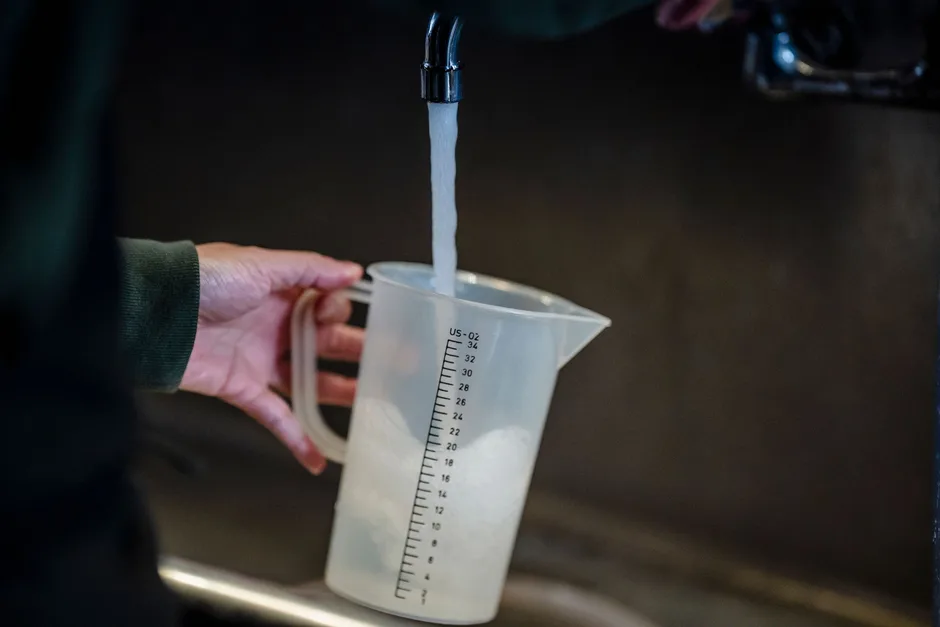
The front garden tap is usually the closest outlet to the meter and the least interfered with: no aerator, no flow regulator, no long run of old pipe, no mixer cartridge. A shower can read miserably while the service to the property is perfect. Testing at the shower tells you about the shower. Testing at the garden tap tells you about the supply.
On most Parramatta houses the meter and the tap that feeds it sit near the front boundary, in a small rectangular box set into the lawn or a garden bed. Some of the older cottages around Harris Park and North Parramatta have it against the front wall instead. In an apartment there may be no garden tap at all, which is exactly why the unit version of this problem works differently.
3. Check the taps and valves someone may have left part closed
This is the most common cause we find where pressure "suddenly" dropped, and it is almost always the tail end of some other job: somebody isolated the water to change a tap or a hot water unit and did not quite finish opening it again. Sydney Water's own advice when pressure drops is to check that the tap at your meter and the controls on your hot water system are fully open, which tells you how often this is the answer.
Four places worth checking, in order:
- The tap at the water meter. Fully open, not "mostly".
- The stop tap where the line enters the house, if the property has one. Freestanding homes often do.
- The mini stops under the kitchen sink, under each vanity and behind the toilet.
- The isolating valve on the cold inlet of the hot water unit. This one throttles the hot side only, which makes it a very good suspect if that is your symptom.
A quarter-turn lever is open when the handle sits in line with the pipe. A wheel-style tap should be wound fully open, then backed off a quarter turn so it does not seize there.
In the pre-1970s housing around Harris Park, North Parramatta and Granville, plenty of these are original brass gate valves that have sat untouched for decades. They seize part open, and they shear off when you lean on them. If it will not move under steady hand pressure, stop. A stuck valve is a cheap job while the water is still on and an expensive one after it snaps.
4. Clean the aerator or showerhead
If one outlet is the problem, this is usually where it ends. Unscrew the aerator from the spout or the head from the arm, rinse the screen, refit it. Five minutes, no tools beyond a cloth to protect the chrome.
Here is the part that most plumbing articles get wrong for this part of the world. What is in there is not limescale. Sydney's drinking water is soft, sitting around 43 mg/L across the network and roughly 50 mg/L out of the Prospect plant, both comfortably under the 60 mg/L threshold where water starts being called hard. There is no chalky mineral crust building up in your fittings here, and no reason to buy a descaler. What actually clogs an aerator in a Parramatta house is grit, flakes of corrosion off ageing galvanised pipe upstream, and bits of perished rubber washer.
You are also allowed to do this. Under the Plumbing and Drainage Act 2011, exempt owner/occupier work includes "repairing a tap or showerhead in a dwelling" and "the installation of water-restricting or flow-regulating devices to tap end fittings (including showerheads)", as long as you own or occupy the place and nobody is paid to do it. The Act carves three fittings back out: a thermostatic mixing valve, a tempering valve and a backflow prevention device. Those are always licensed work.
While the head is off, check what it is rated to deliver. Most showerheads sold in Australia now carry a WELS star rating and are flow limited by design, commonly to around nine litres a minute or less. If the "pressure problem" started the week somebody fitted a new water-efficient head, nothing has failed. That is the product working.
5. Check whether it is only the hot side
Weak hot water with perfectly good cold is a much narrower problem, and it is worth separating from a genuine pressure fault before anyone starts pulling walls apart. Five candidates, in the order we check them:
- The cold inlet valve on the unit is part closed. See step 3. Free to fix.
- The tempering valve is blocking up. NSW requires stored hot water to be kept at 60 degrees for legionella control and tempered down to a maximum of 50 degrees at bathroom and hand basin outlets, so there is a valve in the line doing that. They silt up and they restrict flow. They are also one of the three fittings the owner/occupier exemption specifically does not cover, so this is licensed work.
- The system was never at mains pressure. Some older homes still run a gravity-fed low-pressure hot water system, where the hot side is fed from a tank rather than the main. If that is what you have, the hot side has always been gentler than the cold and no amount of valve hunting will change it.
- The unit itself is on the way out. Sediment in the bottom of a cylinder and a spent sacrificial anode are the normal end-of-life story on a soft supply like ours, and reduced hot flow can be one of the early signs. Our no hot water guide walks through the rest of that diagnosis, and the hot water page covers repair versus replacement.
- It is not actually a pressure problem. Hot water that runs out partway through a shower, at full pressure, is a different fault. Parramatta is on the Endeavour Energy network rather than Ausgrid, and an Endeavour controlled load tank only reheats overnight, so a tank that has been emptied by 6pm stays that way until the small hours no matter what the pressure is doing.
6. Check whether it is Sydney Water's, then call a licensed plumber if it is not
Sydney Water's supply and service updates page gives you the status at your address, and its works near you map shows whether there is a job running nearby. You can register to be told by SMS or email when something local is going to affect supply, and the faults line, 13 20 90, is staffed 24 hours a day. Parramatta sits inside Sydney Water's area of operations, which is why that number is the right one here and would be the wrong one in plenty of other parts of NSW. Signs it is theirs rather than yours: your neighbours have it too, it arrived suddenly rather than creeping up over years, or the water came back discoloured at the same time.
If it is not theirs, it is yours, and from there it is licensed work. In NSW you need a licence or certificate to do any plumbing, draining or gasfitting work regardless of what the work costs, with penalties of $22,000 for an individual and $110,000 for a company. Tracing a restriction inside a wall is real diagnostic work too: isolating sections, testing flow at each one and narrowing down where the bore has closed up, rather than guessing and cutting. We put our licence number, 368473C, on every quote.
Measured under 18 litres, or found nothing at all?
We will trace where the flow is actually being lost, and tell you honestly if it is Sydney Water's to fix.
7. Why water pressure varies so much across Parramatta
Pressure is not one number that Sydney has. It varies street by street, and around here there are four reasons why.
The network runs on gravity. Sydney Water supplies each zone from reservoirs sitting at the high points of that zone and lets gravity do the rest, so properties low in a zone receive higher pressure and properties high in a zone receive less. Most Sydney properties land between 15 and 65 metres head, the network average is 52 metres, and some customers get above 100. Parramatta covers a lot of vertical ground between the river flats and the higher ground to the north and west, so two houses a few streets apart can genuinely be on different pressures. What decides it is where you sit relative to your own zone's reservoir, not how you compare to the next suburb.
Sometimes Sydney Water lowers it deliberately. Its Water Pressure Management Program targets areas where pressure runs higher than average and brings it down with pressure reduction valves, because "high water pressure can lead to breaks in water pipes and cause leaks in our water system". Sydney Water is upfront that the trade-off is slower flow and longer fill times for baths and washing machines, and that some instantaneous hot water systems, corroded galvanised pipes and existing pressure-reducing valves may need upgrading afterwards. Whether your zone has been through it is a question for 13 20 90.
Old galvanised pipe closes itself in. Plenty of the pre-1970s housing in Harris Park, North Parramatta and Granville still runs on the original galvanised steel. It rusts from the inside out and the bore narrows year after year. The pressure at the main never changed; the pipe stopped being able to carry it. That is why Sydney Water names corroded galvanised pipe as one of the things that struggles when network pressure comes down, and why a house that was fine a decade ago now runs one shower at a time.
The ground moves. Much of Parramatta sits on the Cumberland Plain, underlain by Wianamatta shale, which weathers to clay soils recognised as reactive with appreciable shrink-swell capacity. Across a Sydney year of wet spells and dry spells that ground lifts and drops the pipes buried in it, and it works joints apart. A cracked service line between the meter and the house bleeds pressure continuously, and on a whole-house pressure loss with no obvious cause it is high on our list. It also turns up on the bill long before it turns up as a puddle. There is more on that in our burst pipe guide and on the leaks and burst pipes page.
One more worth knowing: a pressure limiting valve, fitted to protect the house from high mains pressure, is a wearing part. When one ages out, or was set conservatively to begin with, every outlet pays for it. Five minutes to check, and invisible from inside the bathroom.
8. Low pressure in a Parramatta apartment: whose valve is it?
At the 2021 Census, 85.6% of Parramatta's occupied private dwellings were flats or apartments, against 7.7% separate houses. So in this suburb the strata version of this problem is the normal case, not the exception, and two things change about it.
The 15 metres head is measured at the ground, not at your tap. Sydney Water's Customer Contract commits it to "a minimum of 15 metres head of pressure at the connection point to our drinking water system". Metres head is literally the height the water will rise, so 15 metres of it, measured where a tower meets the street, was never going to reach level 14 on its own. The building's booster pump set does that. When a pump set starts failing, the symptom shows up on the top floors first and works its way down, which is why asking a neighbour several floors below you is worth more than any test you can do in your own kitchen.
The valve on your line may not be yours. Under the NSW common property memorandum made under section 107 of the Strata Schemes Management Act 2015, the owners corporation's plumbing responsibilities include the "main stopcock to unit" and "pipes within common property wall, floor or ceiling". The lot owner's list starts further down: "pipes, downstream of any stopcock, only serving that lot and not within any common property wall". So a seized or half-shut stopcock feeding your unit is the building's to fix, not yours, and neither is the pipe running inside the common wall behind your bathroom. The caveat that always applies: the memorandum only binds where the scheme has adopted it, and your by-laws govern.
Practical version: ask two neighbours, one on your floor and one well above or below. Whole building weak, or the top few floors, is a strata manager's job. Only your unit is your line, starting at your stopcock.
9. Five things that make low pressure worse
- Leaning on a stiff valve. Old brass shears. You will turn a pressure complaint into a burst pipe and a wet hallway.
- Ripping the restrictor out of a showerhead. If the head was not the problem, you have not fixed anything, you have just made the shower use more water to feel the same.
- Buying a descaler. Sydney's supply is soft, Parramatta included. There is no limescale to dissolve, and the acid has to go somewhere, which is usually your tap seals.
- Leaving a whole-house drop for months. Gradual loss across every outlet is often a leak on the buried service line, which in Parramatta's reactive shale clay is exactly where these things fail, and you pay for every litre of it in the meantime. Sydney Water's hidden leak allowance is specifically for hidden leaks: it says it cannot offer one for "visible leaks. This includes damp soil or consistently wet grass". Waiting until the lawn tells you is the version that is not covered.
- Doing the pipework yourself. Everything past a tap washer, a showerhead or a flow regulator is licensed work in NSW regardless of what it costs, and unlicensed work is the sort of thing an insurer reads carefully after a flood.
10. When low pressure is urgent, and when it can wait
Most low pressure is not an emergency, and we would rather say so than sell an after-hours call-out. Ring straight away, day or night, if:
- there is no water at all, or the whole property dropped to nothing in a matter of hours
- the pressure fell and the water came back discoloured
- pressure is down and you can hear water running with every tap shut, or there is a wet patch, a soft spot in the lawn or water surfacing on the driveway, which reads as a failed service line
- the hot side lost pressure and the relief valve on the unit is discharging
It can wait for a normal appointment if it is one outlet, if it has crept down over years, if it started when a new showerhead or filter went in, or if you are high up in a Parramatta block and it only sags in the morning peak. None of those get worse tonight.
If you rent, the line sits in a slightly different place. Section 62 of the Residential Tenancies Act 2010 defines urgent repairs to include a burst water service and "an appliance, fitting or fixture that uses water or is used to supply water that is broken or not functioning properly, so that a substantial amount of water is being wasted". Plain low pressure with nothing leaking is not that, so it goes in as an ordinary repair request. A service line quietly running under the yard is.
11. The $46 rebate almost nobody claims
Sydney Water's Customer Contract 2024-2028 sets out what happens when it does not deliver, and low pressure is on the list. Clause 12.2(8): "If we assess your property as having experienced low drinking water pressure you are entitled to a rebate of $46." Where its own monitoring picks the event up, the rebate is applied automatically. One per quarter.
The trigger is defined precisely: low drinking water pressure means pressure at the connection point to the water main "below 15m head of pressure for a continuous period of one hour". It is not payable if the cause was an unplanned interruption, an ongoing planned one, water use during a fire or other abnormal demand, or a short-term operational problem such as a main break fixed within four days.
There is one more exclusion, and it is the reason this section belongs on a Parramatta page. The rebate does not apply near a "property cluster", meaning identified properties affected by recurring low water pressure, and the Operating Licence names six areas: Kurrajong, North Richmond, Horsley Park, Bass Hill, Buxton and Denham Court. Not one of them is anywhere near here. Sydney Water has never written this suburb down as a place where low pressure is simply how it is, so "that is normal around here" is not an answer you should accept, from us or anyone else.
Two neighbours of the pressure rebate are worth knowing about too, because most people never notice they were owed them:
- An unplanned interruption of more than five hours caused by a Sydney Water failure is an automatic $46, for the first and second event in a rolling 12 months.
- Three or more unplanned interruptions of over an hour each in a rolling 12 months entitles you to a rebate equal to the whole annual water service charge. At the 2026-27 residential price of $26.65 a quarter, that is about $106.60 across the year, less any concessions.
- A planned interruption of more than five hours is an automatic $23, every time.
Those are the first-year figures in the 2024-2028 contract and they rise annually with CPI, so check the current numbers when you claim.
One last thing, almost unknown and genuinely useful: Sydney Water will make free repairs to leaks on your water pipes between the point of connection to its main and one metre along the pipe inside your property boundary, provided the connection is authorised, it can access the pipe, the damage is not negligent and the pipework was installed to the relevant codes. If your pressure loss traces to a leak right at the boundary, ask about that before you pay anyone to dig.
- One minute and a bucket at the front garden tap settles the biggest question: 18 litres a minute or more means Sydney Water is delivering, and the restriction is yours.
- Under 18 litres, ring 13 20 90 before you ring a plumber, and ask about the $46 low pressure rebate while you are on the phone.
- Hot-only weakness is a different problem: the cold inlet valve, the tempering valve, or a system that was never on mains pressure.
- Around Parramatta, the usual internal culprits are ageing galvanised pipe closing in on itself and a service line cracked by reactive shale clay.
- In an apartment, the stopcock feeding your unit is on the owners corporation's list, not yours, and the network was never expected to reach level 14 without a pump.
- It is not limescale. Sydney's water is soft, and a descaler will do nothing here except attack your seals.
Low water pressure FAQs
How much water pressure should I be getting in Parramatta?
Sydney Water's Customer Contract commits it to a minimum of 15 metres head of pressure at the point where your property connects to its system, and it says that equals a flow of 18 litres a minute at the garden tap. Most Sydney properties sit between 15 and 65 metres head, the network average is 52 metres, and some customers receive above 100 metres. Because the network is gravity fed from reservoirs at the high points of each supply zone, properties low in a zone get more pressure and properties high in a zone get less, which is why pressure varies between Parramatta streets.
Is low water pressure just normal in some parts of Parramatta?
No, and Sydney Water's own paperwork says so. Its Customer Contract excludes the low pressure rebate for properties near a "property cluster", meaning identified properties affected by recurring low water pressure, and the Operating Licence names six such areas: Kurrajong, North Richmond, Horsley Park, Bass Hill, Buxton and Denham Court. None of them is in or near Parramatta. If your property is persistently under 18 litres a minute at the garden tap, that is a fault to be investigated, not a feature of the suburb.
My whole apartment block has weak pressure. Who is supposed to fix it?
Almost certainly the owners corporation, via the strata manager. Sydney Water's 15 metres head obligation is measured at the connection point where the building meets its main, at ground level, and metres head is literally the height water will rise, so a tower relies on its own booster pump to get water to the upper floors. On top of that, the NSW common property memorandum puts the "main stopcock to unit" and "pipes within common property wall, floor or ceiling" on the owners corporation's list, and only starts the lot owner's responsibility at pipes downstream of that stopcock that serve your lot alone. The memorandum applies where the scheme has adopted it, so check your by-laws.
Can Sydney Water lower my water pressure on purpose?
Yes. Its Water Pressure Management Program targets areas across Greater Sydney where pressure runs higher than average and reduces it using pressure reduction valves, because high pressure causes breaks and leaks in the network. Sydney Water is open about the trade-off: slower flow and longer fill times for baths and washing machines, and it notes that some instantaneous hot water systems, corroded galvanised pipes and existing pressure-reducing valves may need upgrading afterwards. Ring 13 20 90 to find out whether your supply zone has been through it.
Could hard water or limescale be blocking my pipes?
Not in Parramatta, and not anywhere on the Sydney Water network. The supply here is soft, around 43 mg/L across the network and roughly 50 mg/L out of the Prospect plant, both well under the 60 mg/L mark where water is called hard. There is no limescale build-up narrowing your pipes. What does narrow them is internal rust in ageing galvanised steel, which is common in the pre-1970s housing around Harris Park, North Parramatta and Granville, and what clogs an aerator is grit, corrosion flakes and perished washer rubber. Descaling products are money wasted here.
What am I allowed to fix myself in NSW?
The Plumbing and Drainage Act 2011 lets the owner or occupier of a dwelling repair a tap or showerhead, and install water-restricting or flow-regulating devices to tap end fittings including showerheads, as long as nobody is paid for the work. That covers cleaning an aerator or a showerhead screen. It specifically does not cover a thermostatic mixing valve, a tempering valve or a backflow prevention device. Everything beyond that needs a licence or certificate regardless of what the job costs, with penalties of $22,000 for an individual and $110,000 for a company.