A dripping tap is the fault people live with longest. It is not an emergency, it does not flood anything, and there is always something more urgent. It is also the only plumbing job in New South Wales that the law names as one you are allowed to do in your own home, which is why so much bad advice has grown up around it.
The permission is real, and it is narrower than the internet thinks. Here is exactly where the line sits, how to do the part that is yours, what the drip is costing you on a Sydney Water bill while you decide, and which taps have to be a licensed plumber no matter whose house it is.
You may repair a tap or showerhead in your own home without a licence. The Plumbing and Drainage Act 2011 writes that exemption out by name, and it is the only plumbing work an owner or occupier can legally do. It stops at three fittings, and it covers repairing a tap, not replacing one.
- Shut the water to that tap, at the mini stop or the main
- Check it is not a mixing, tempering or backflow valve
- Work out if it is a washer tap or a cartridge tap
- Change the washer and the o-ring together
- Still dripping? The brass seat is worn, not the washer
- Book out the ones you cannot legally touch
On this page
- Shut the water off to that tap
- Check it against the three exceptions
- Work out which kind of tap it is
- Change the washer and the o-ring
- If it still drips, look at the seat
- Book out the rest properly
- What the drip is costing you
- Why taps wear out around Parramatta
- Five things that make it worse
- Urgent, or can it wait?
- Renting or in strata? Who pays
1. Shut the water off to that tap
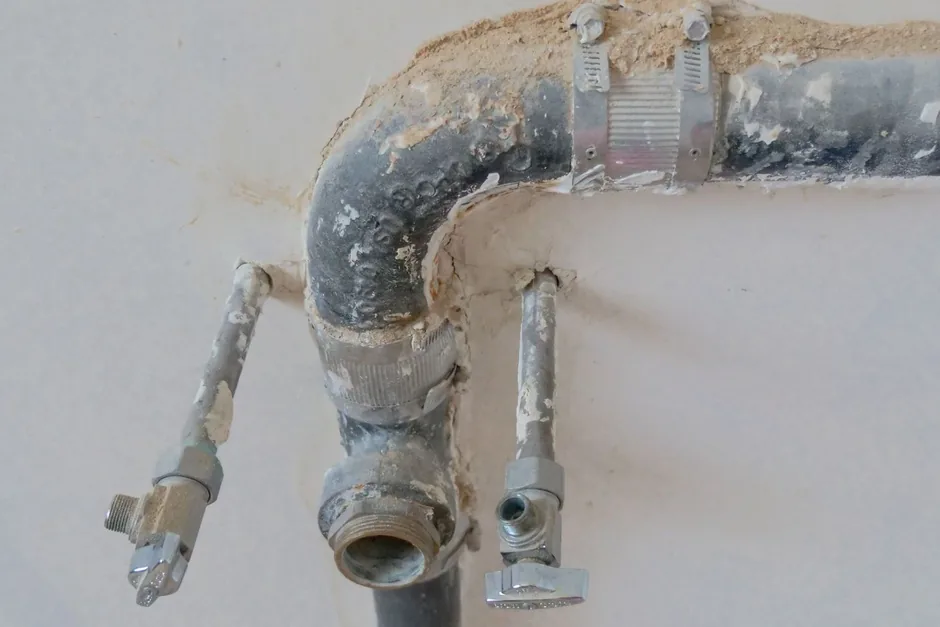
Start here, before you unscrew anything. Most kitchens and vanities built in the last few decades have a pair of small chrome mini stop taps sitting on the pipes under the sink, one for hot and one for cold. Turn the one feeding the dripping tap clockwise until it stops, then open the tap itself to prove the water is actually off and to drain what is left in the line.
If there are no mini stops, you are shutting the whole house down at the main tap, which on most Parramatta houses sits near the front boundary in a small box in the lawn beside the meter. Older cottages around Harris Park and North Parramatta sometimes have it against the front wall instead.
In a flat it is different again. Your isolation valve is usually under the sink or in the riser cupboard on your level. The main stopcock to your unit is not yours: the NSW common property memorandum lists the "main stopcock to unit" under the owners corporation's responsibilities, so if the only way to stop the water is out in the fire stairs, that is a call to building management rather than a job for your shifter.
A mini stop that has not moved in fifteen years can look shut and still pass water. Open the tap and give it a full minute. If it keeps running, the mini stop has failed and you are back to the main, which is worth knowing before the spindle is out and in your hand.
2. Check your tap against the three exceptions
New South Wales is blunt about plumbing. The Building Commission's own line is that "in NSW, you need a licence or certificate to do any plumbing, draining or gasfitting work regardless of the cost of the work or whether the work is residential, commercial or industrial", with published fines of $22,000 for an individual and $110,000 for a company.
Taps are the exception, and it is written into the Act rather than left to custom. Section 4(5)(e) of the Plumbing and Drainage Act 2011 says plumbing and drainage work does not include "exempt owner/occupier work", being work that "involves repairing a tap or showerhead in a dwelling (other than a repair of a thermostatic mixing valve, tempering valve or backflow prevention device) or the installation of water-restricting or flow-regulating devices to tap end fittings (including showerheads) in a dwelling", carried out by the owner or occupier, or by "a person authorised to carry out the work by the owner or occupier of the dwelling who does not receive payment or other consideration for carrying out the work".
Read that twice, because four things are hiding in it.
- It says repairing, not replacing. Changing the washer in the tap you have is exempt. Taking the old tap set off and putting a new one on is not a repair, and it is not exempt.
- Three fittings are carved back out. A thermostatic mixing valve, a tempering valve and a backflow prevention device are all named. The tempering valve is the brass one near your hot water unit that keeps bathroom outlets at no more than 50 degrees while the tank stores at 60 for legionella control. If your hot tap has started running scalding, that valve is the likely cause and it is licensed work.
- Money ends the exemption. A neighbour who is good with tools can legally do it for you. The moment they are paid, in cash or in "other consideration", they need a licence and you both have a problem.
- It says owner or occupier. Renting does not remove the exemption under this Act. Your tenancy agreement is a separate question, and there is a section on that below.
There is a local wrinkle worth flagging before you start. In a Parramatta flat you are the "occupier of the dwelling" the Act is talking about, so the exemption is yours. It runs out at the tap, though, not at the wall: the pipework behind a wall-mounted set can be common property, and no exemption in the Plumbing and Drainage Act gives you the right to open somebody else's wall.
Everything outside those lines is section 6 territory: plumbing work that must be done by the holder of an endorsed contractor licence or supervisor certificate, or under their supervision, with a maximum penalty of 100 penalty units.
3. Work out which kind of tap it is
Half the failed DIY tap repairs we get called to are someone hunting for a washer in a tap that has never had one. Turn the handle and count.
A washer tap is the traditional kind: separate hot and cold, and the handle turns through a full revolution or more before it shuts. Inside is a spindle with a rubber washer on the end, closing onto a brass seat. This is the one the exemption was written for.
That matters more here than in most suburbs, because the standard Parramatta fitting is not the standard plumbing-article fitting. A quarter turn tap stops after ninety degrees. Inside is a ceramic disc cartridge, not a washer, and there is nothing to re-wash. A flick mixer, the single lever that swings for temperature, is the same story with a bigger cartridge buried in the body.
Where the water appears tells you the rest. Dripping from the spout means the part that shuts the flow has failed: a washer, or a cartridge. Weeping from under the handle or around the base when the tap is running means an o-ring, and water coming out of the wall behind a wall-mounted tap is not a tap problem at all.
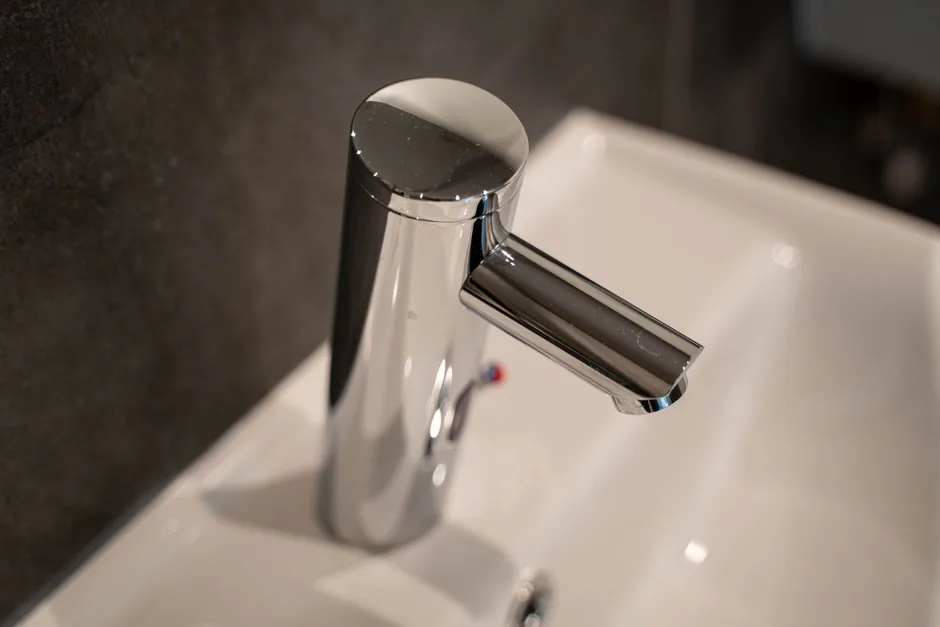
One myth worth killing while you are down there. Sydney's water is soft, roughly 43 milligrams per litre across the network and about 50 out of Prospect, both comfortably under the 60 threshold. Every overseas article blaming limescale on the seat is describing a problem this city does not have. Around here a tap fails because rubber perishes and brass wears, which is why the repair is cheap and why it comes back if you only do half of it.
4. Change the washer and the o-ring together
With the water off and the tap open, put the plug in the basin first. Every plumber has fished a grub screw out of a trap and none of us enjoy it.
- Lever off the hot or cold button on top of the handle, and undo the small screw underneath. The handle lifts off.
- Undo the chrome shroud or bonnet with a shifter, with a cloth around it so the jaws do not chew the chrome.
- The spindle unscrews out. On the end is either a washer held by a small brass nut, or a loose jumper valve sitting in the body that you tip out.
- Take the old washer with you to buy the new one. They are not all the same size and guessing wastes the afternoon.
- Change the o-ring on the spindle while it is in your hand. That is the seal that stops the weep under the handle, it costs almost nothing, and going back in for it later is the annoying part.
- A smear of tap grease on the thread and the o-ring, then reassemble. Nip it up firmly and stop. Overtightening is what wrecks the next seat.
Plenty of pre-1970s homes in Harris Park, North Parramatta and Granville still run original brass tapware on galvanised pipe. A bonnet that has been in place for fifty years can seize solid to the tap body, and leaning on it can crack the body or twist the tail off inside the wall. That turns a five dollar washer into a burst pipe and an opened wall. If it will not move with a shifter and steady pressure, put it down and book it in.
5. If it still drips, look at the seat
A new washer that drips again within a fortnight almost always means the seat is gone. The seat is the machined brass ring the washer closes onto, and grit and years of overtightening score a groove into it. Nothing you screw into a damaged seat will hold, and putting a harder washer in only cuts it faster.
The fix is a reseating tool that re-cuts the brass flat, and it is genuinely quick in the right hands. On the pre-1970s brass still in service around Harris Park and North Parramatta the seat is often worn past re-cutting, and at that point the honest answer is a new tap set rather than a third washer. That is a replacement, so it crosses back out of what you may do yourself.
6. Book out the ones you cannot legally touch
There are two sensible routes here, and one of them is cheaper than calling us, so we may as well say so. Sydney Water runs a subsidised repair service for exactly this fault, and a licensed plumber handles everything it will not touch.
Sydney Water's WaterFix Residential covers exactly this job. Their published schedule of services and charges, dated 21 July 2026, prices "minor tap leak repairs (each repair)" at $0, and defines it as a repair that "includes washer and o-ring replacement and reseating the tap". Tap seat replacement is also listed at $0. What you pay is the callout: $44, or $16.50 for pension card holders on the first appointment. Bookings are on 1800 807 475. It is a Sydney Water area service, so Parramatta and the surrounding suburbs are covered, and it stops at the edge of their network.
The exclusions are the important half, and they are the schedule's own words. A minor tap leak repair "does not include repairs to flick mixers, outdoor taps, ceramic cartridge taps or quarter turn mixing taps". A leaking outdoor tap is priced as a replacement instead, also at $0. Appointments run business hours, with a $44 Saturday surcharge and $55 after 6pm.
So if you have a standard washer tap in Sydney Water's area and you can wait for a weekday appointment, that is the call to make before ours. If you have a mixer, a ceramic cartridge, a wall-mounted set whose body sits inside the wall, a tempering or mixing valve, or a tap that needs the wall opened to reach it, that is licensed leak and tap repair work and the exemption never covered it.
Tap you cannot fix yourself?
Mixers, wall sets and tempering valves are licensed work. A local plumber can quote it upfront.
7. What that drip is actually costing you
Sydney Water publishes three different figures for a dripping tap, which looks careless until you realise a drip is not one thing. Their numbers: "a tap dripping just one drop a second can waste 7,000 litres a year", "a dripping tap can waste up to 2,000 litres of water a month", and "a dripping tap can waste as much as 200 litres a day".
Residential drinking water usage is charged at $3.41 a kilolitre from 1 July 2026 to 30 June 2027. Run their three figures through it:
- One drop a second. 7 kilolitres a year, so about $24 a year and roughly $6 on a 92 day quarter. Annoying, not expensive.
- 2,000 litres a month. 24 kilolitres a year, $81.84 a year, or $20.46 a quarter.
- 200 litres a day. 73 kilolitres a year, $248.93 a year, and $62.74 on a 92 day July or October quarter.
For scale, Sydney Water puts typical quarterly charges for a house at $387.03 for water and wastewater services using 50 kilolitres. A tap at the top of that range adds 18.4 kilolitres to the same quarter, which is a third again on the water you actually use. They also reckon each person in Sydney gets through about 200 litres of drinking quality water a day, so a badly dripping tap is a whole extra person living in your house and paying no rent.
Whether you ever see that number is a separate question in Parramatta, where most homes are flats rather than houses. It comes down to whether your block has its own meters, and there is more on that further down.
Then there is the part that catches people. Sydney Water's hidden leak allowance, the goodwill credit worth 50% of the usage charge for the most impacted quarter and available once every five years per property, explicitly does not apply here. Their words: "we can't offer hidden leak allowances for visible leaks. This includes damp soil or consistently wet grass, or on taps, toilet cisterns, dishwashers or washing machines." A dripping tap is the definition of a visible leak. There is no safety net, and you pay for every litre of it.
Sydney Water's meter test settles it. Turn off every tap and appliance that uses water, including drip systems, dishwashers and washing machines, find your meter and note the numbers, then "don't use any water for at least the next hour" and check the last numbers on the dial again. If they have moved and your tap is now shut, something else is leaking too.
Worth knowing as well: the Water Wise Guidelines are mandatory across Greater Sydney every day of the year, not just in a drought. Two of the rules are "hoses and taps must never be left running unattended" and "if we've given you a notice to fix a leak, you must do it by the deadline we've set".
8. Why taps wear out around Parramatta
Taps fail everywhere. What differs here is why, and how fast.
Pressure, and a lot of it in some streets. Sydney Water supplies by gravity: reservoirs sit at the high point of each supply zone and the water runs downhill from there, which is why, in their words, "properties in low areas receive higher water pressure". Most properties get between 15 and 65 metres head, the network average is 52 metres, and some customers are above 100. Parramatta covers a lot of vertical ground for one postcode. The CBD, Harris Park and Rosehill sit on the river flats, and the land climbs away north and west toward Northmead, Oatlands and Winston Hills. Two homes ten minutes apart can be at opposite ends of that pressure range, and the one at the bottom of the hill goes through washers faster than the one on the ridge.
Not limescale. Soft water again. If your tap has failed twice in two years, the cause is pressure, a scored seat or a cheap washer, and any advice that starts with descaling was written for a different country.
Old brass in the older streets. The pre-1970s housing through Harris Park, North Parramatta and Granville still carries plenty of original tapware on galvanised pipe. Seats are worn past re-cutting, bonnets are seized, and the tail behind the tap is corroded thin. On those homes the honest answer is often a new tap set rather than another washer, and that crosses out of the exemption.
It is an apartment suburb, so the typical tap is a mixer. At the 2021 Census, 85.6% of Parramatta's occupied private dwellings were flats or apartments and only 7.7% were separate houses. That flips the usual advice on its head. For most people reading this locally, the tap is a flick mixer with a cartridge, there is no washer in it, and the pipe behind it may not belong to them either.
9. Five things that make a leaking tap worse
- Cranking it harder to stop the drip. This is the single most common cause of a ruined seat. The handle is not a clamp.
- Leaving it because it is only a drip. At the top of Sydney Water's range it is $248.93 a year, and none of it is claimable.
- Buying a washer by eye. Take the old one in. A near enough washer drips within a month.
- Tape or sealant around the base. A weep at the base is a perished o-ring inside. Wrapping the outside just hides where the water is going.
- Assuming it is limescale. Parramatta is on soft water, so descaling products achieve nothing here. The grit that scored your seat came off the inside of the pipework, not out of the supply.
- Paying a mate to do it. The exemption covers an unpaid helper only. Once money changes hands it is unlicensed plumbing work, and your insurer will read the same section we just quoted.
10. When a leaking tap is urgent, and when it can wait
Most of the time, it waits. A drip from the spout on a tap you can isolate is a booking, not a callout, and anyone telling you otherwise at 11pm is selling something.
Do not sit on it if the water is weeping from under the handle or the base and running down the vanity or into the cabinetry, because that quietly destroys chipboard and plaster long before anyone calls it a leak.
Call straight away if you cannot shut the water off to it, if water is coming out of the wall behind the tap rather than the spout, if your hot tap has started delivering scalding water, or if you are in one of Parramatta's unit blocks and the water is tracking towards a neighbouring lot. That last one stops being your repair bill and starts being someone else's ceiling.
11. Renting or in a strata block? Who pays for what
Given how much of Parramatta lives in flats, this is the section most local readers actually need.
In strata, the NSW common property memorandum splits it item by item. Under the lot owner's plumbing responsibilities it lists "taps and any associated hardware", along with the "pipes and 'S' bend beneath sink, laundry tub or hand basin". Under the owners corporation's, it lists "pipes within common property wall, floor or ceiling" and the "main stopcock to unit". So the dripping spout is yours, and the moment the fault is in the pipe inside a common property wall it is not. Wall-mounted tapware is where that argument usually starts. The memorandum only binds where your scheme has adopted it by by-law, so check your by-laws before anyone quotes it at you.
Whether the wasted water even reaches a bill with your name on it depends on the building's age. Sydney Water has required individual metering for most new multi-level developments since 1 September 2014, tied to Section 73 Compliance Certificate applications after that date. In an older block on a single common meter, the water goes onto the owners corporation bill and comes back to you through the levies instead.
If you rent, the landlord "must provide and maintain the residential premises in a reasonable state of repair". A dripping tap is normally a non-urgent repair, so put it in writing with a reasonable deadline and let the agent arrange it. A badly leaking one may not be non-urgent at all: the Residential Tenancies Act 2010 lists among urgent repairs "an appliance, fitting or fixture that uses water or is used to supply water that is broken or not functioning properly, so that a substantial amount of water is being wasted". Where a repair is urgent and the landlord will not act, a tenant can arrange it and be reimbursed up to $1,000, and the landlord must pay it back "not later than 14 days after being given a written notice from the tenant". The Act also expects the work to have been "carried out, if appropriate, by licensed or otherwise properly qualified persons", which is one more reason not to have a mate do it for beer money.
- NSW law lets an owner or occupier repair a tap or showerhead in their own home, unpaid help included, but not a thermostatic mixing valve, tempering valve or backflow prevention device.
- Repairing your tap is exempt. Replacing the whole tap set is plumbing work and needs a licence.
- Only washer taps have washers. A quarter turn tap or a flick mixer has a cartridge, and there is nothing in it to re-wash.
- At Sydney Water's own figures a drip runs from about $24 to $248.93 a year, and the hidden leak allowance specifically excludes taps.
- Sydney Water's WaterFix will do a washer, o-ring and reseat for a $44 callout, and a licensed plumber (ours is 368473C) takes the rest.
Leaking tap FAQs
Can I legally change my own tap washer in NSW?
Yes. Section 4(5)(e) of the Plumbing and Drainage Act 2011 excludes "exempt owner/occupier work" from plumbing and drainage work, which covers repairing a tap or showerhead in a dwelling by the owner or occupier, or by someone they authorise who "does not receive payment or other consideration for carrying out the work". It does not cover a thermostatic mixing valve, a tempering valve or a backflow prevention device, and it covers repairing a tap rather than replacing one.
Can I replace the whole tap myself?
No. The exemption is written around repairing a tap, not swapping it out. Replacing tapware is plumbing work, and while clause 11 of the Plumbing and Drainage Regulation 2017 exempts "tap ware replacements" from the Notice of Work and Certificate of Compliance paperwork, the note under that clause states that all the other provisions of the Act still apply, including section 6, which requires the work to be done by or under the supervision of a licence or certificate holder. The paperwork exemption gets misread as a licence exemption constantly.
Will Sydney Water fix my dripping tap?
In most cases yes, and cheaply. WaterFix Residential's schedule dated 21 July 2026 prices minor tap leak repairs at $0, described as a repair that "includes washer and o-ring replacement and reseating the tap", with tap seat replacement also at $0. You pay a $44 callout, or $16.50 on a first appointment with a pension card, and bookings are on 1800 807 475. It "does not include repairs to flick mixers, outdoor taps, ceramic cartridge taps or quarter turn mixing taps", which is where a licensed plumber comes in.
What is a dripping tap costing me in Parramatta?
Sydney Water quotes 7,000 litres a year for a tap dripping one drop a second, up to 2,000 litres a month for a steadier drip, and as much as 200 litres a day at the worst. At the 2026 to 2027 residential rate of $3.41 a kilolitre that is roughly $24, $81.84 and $248.93 a year. Their hidden leak allowance cannot help, because it excludes visible leaks "on taps, toilet cisterns, dishwashers or washing machines".
My tap is in a Parramatta apartment. Is it mine or the owners corporation's?
The NSW common property memorandum lists "taps and any associated hardware" as the lot owner's responsibility, along with the pipes and S bend beneath a sink, laundry tub or hand basin. It puts "pipes within common property wall, floor or ceiling" and the "main stopcock to unit" on the owners corporation. So the tap is yours and the pipe inside a common wall generally is not, which is why wall-mounted tapware causes arguments. The memorandum only applies where your scheme has adopted it, so the by-laws are the final word.
Why does my tap keep dripping after I put a new washer in?
Nine times out of ten the brass seat under the washer is scored, usually from grit or from years of the handle being cranked shut hard. A new washer cannot seal against a grooved seat, so it drips again within weeks. The seat has to be re-cut with a reseating tool. Sydney's water is soft, around 43 milligrams per litre, so this is wear rather than the limescale that overseas guides blame.