A shower head that drips after everyone has finished is the fault people live with longest. It is not an emergency, nothing floods, and there is always something more pressing. It is also one of only two plumbing jobs New South Wales law names as yours to do, which is why so much confident, wrong advice has grown up around it. The problem is that the drip you can see is often not coming from the part you are allowed to touch, and separating those two takes about ten minutes and no tools at all.
Here is how to find where the water is actually starting, what you may legally do about it in your own home, and the point at which the honest answer is to stop and book it out. If water is already showing on a ceiling below you, skip ahead to checking whether it has got behind the tiles, because that is a different and more expensive problem.
Towel the head dry, turn both taps off firmly, and come back in ten minutes. Water left sitting in the head and the arm drains out for a minute or two after a shower, and that is normal. A head still making new drops half an hour later is not leaking from the head at all: the tap or mixer behind the wall has stopped sealing, and that part is not yours. NSW law lets you repair the head itself, and it stops at three fittings.
- Dry the head, then time the drip
- Find out whether it is the face, the swivel or the wall
- Check it against the three fittings you may not touch
- Take the head off and clean it
- Re-seal the thread and refit it
- Still dripping with the taps off? Stop, it is the tap
- Check whether water is getting behind the tiles
- Book out the part that is not yours
On this page
- Dry the head, then time the drip
- Find where the water actually starts
- The three fittings you may not touch
- Take the head off and clean it
- Re-seal the thread and refit
- When the drip means the tap
- Has water got behind the tiles?
- Book out the rest properly
- Why shower heads fail around Parramatta
- Five things that make it worse
- Urgent, or can it wait?
- Renting in Parramatta
- In a flat? Who pays for what
1. Dry the head, then time the drip
Start here, because it decides everything that follows and it costs you ten minutes. Wipe the face of the rose dry with a towel, close both taps, and walk away.
Close them firmly, not hard. A tap hauled shut with body weight to stop a drip is how a good washer gets flattened and a brass seat gets scored, which turns one small fault into two. If you have to lean on a tap to stop the water, the tap is already the problem and the shower head is innocent.
Water held in the head and in the shower arm has to go somewhere, so a minute or two of drips after you turn off is normal and means nothing is wrong. A rail shower with a flexible hose holds more and takes longer, and a ceiling-mounted rain head on a long drop can dribble for several minutes purely because there is a column of water in the pipe above it. Come back at ten minutes and again at thirty. New drops at thirty minutes are new water, arriving under mains pressure, and that is a tap that is not sealing.
If you are in a freestanding home, you can settle the question outright. Turn off every tap and water-using appliance, then go and read the meter at the front boundary. Some meters carry a small leak detection dial that spins on the tiniest flow. Sydney Water's own method for testing a service is to take a reading, wait, and take another. If the numbers move with everything shut, you have a leak somewhere, and it is worth knowing that before you start unscrewing things.
At the 2021 Census, 85.6% of Parramatta's occupied private dwellings were flats or apartments, 10,062 of them. In an apartment there is usually no individual meter you can walk out and read, so the meter test is off the table and the ten-minute dry-and-watch is the whole diagnosis. That is not a limitation the overseas guides on this topic have any reason to mention, and it is the normal case here.
2. Find where the water actually starts
"The shower head is leaking" covers three different faults with three different owners. Dry all three points with a towel, run the shower for thirty seconds, turn it off, and then look immediately with a phone torch. Whichever one beads up first is your answer.
- Out of the nozzles, on the face of the rose. Water is still getting through the tap and finding the only way out. If it stops within a couple of minutes it is drain-down. If it does not, go to section 6.
- From the swivel joint, where the head meets the arm. The rubber washer or O-ring inside the nut has perished, or the nut has worked loose. This one is genuinely yours and it is the cheapest repair in plumbing.
- From the thread at the wall, running back down the arm. This is the one that matters. Water tracking down the arm at the wall face is going somewhere you cannot see, and in a unit that somewhere is a wall shared with a bathroom, a cupboard or a neighbour.
The third one is easy to miss because it looks like splash. Run a dry finger around the arm where it enters the tiles. If it comes away wet after the shower has been off for ten minutes, that is not splash.
It is also the one worth taking seriously in this suburb rather than filing under "I will get to it". In a freestanding house, water at the wall thread has a cavity and a subfloor to disappear into and you will find out eventually. In a flat, and 85.6% of Parramatta's occupied private dwellings were flats or apartments at the 2021 Census, the wall behind that arm is quite often not yours at all, and who pays to open it up is decided by where your lot actually ends.
3. Check it against the three fittings you may not touch
New South Wales is unusually blunt about plumbing. The Building Commission's published position is that in NSW you need a licence or certificate to do any plumbing, draining or gasfitting work regardless of the cost of the work or whether it is residential, commercial or industrial, with fines of $22,000 for an individual and $110,000 for a company. Almost nothing is carved out of that.
Shower heads are one of the carve-outs, and it is written into the statute rather than left to custom. Section 4(5)(e) of the Plumbing and Drainage Act 2011 puts "exempt owner/occupier work" outside the definition of plumbing and drainage work, being work that "involves repairing a tap or showerhead in a dwelling (other than a repair of a thermostatic mixing valve, tempering valve or backflow prevention device) or the installation of water-restricting or flow-regulating devices to tap end fittings (including showerheads)", carried out by the owner or occupier, or by someone they authorise who is not paid for it.
Read the bracket, because it is the whole safety net. Three fittings are named and excluded:
- A thermostatic mixing valve. Common in aged care, health and some apartment buildings, where the water is tempered centrally before it reaches you.
- A tempering valve. The valve that limits the temperature delivered to a bathroom. If your hot water system feeds a bathroom at a controlled temperature, one of these is doing it.
- A backflow prevention device. Rarer on a domestic shower, but it exists.
Two more limits worth reading carefully. The exemption says repairing, not replacing, and it says a tap or showerhead, not the mixer body buried in the wall behind it. Unscrewing the rose, cleaning it and putting it back is squarely inside the line. Opening the wall is not, whoever owns the house.
4. Take the head off and clean it
If the drip is from the face or the swivel and it has stopped once the line drained, this is the whole job.
Isolate the water first. Showers rarely have the little chrome mini stop taps you get under a sink, so in a house you are usually shutting the main tap at the front boundary, in the meter box in the lawn. Older cottages around Harris Park and North Parramatta sometimes have it against the front wall instead. In a unit, look for an isolation valve in your own riser cupboard or under the sink. The main stopcock to unit is listed in the NSW common property memorandum as the owners corporation's responsibility, so if the only shut-off is out in the fire stairs, that is a call to building management rather than a job for your shifter.
Unscrew the head anticlockwise. Hand tight is usually enough after a few years, and if it needs a shifter, wrap the nut in a cloth first so you do not chew the chrome. Inside you will find a rubber washer or O-ring seated in the nut, and often a small plastic flow regulator disc behind it. Both are cheap and both perish.
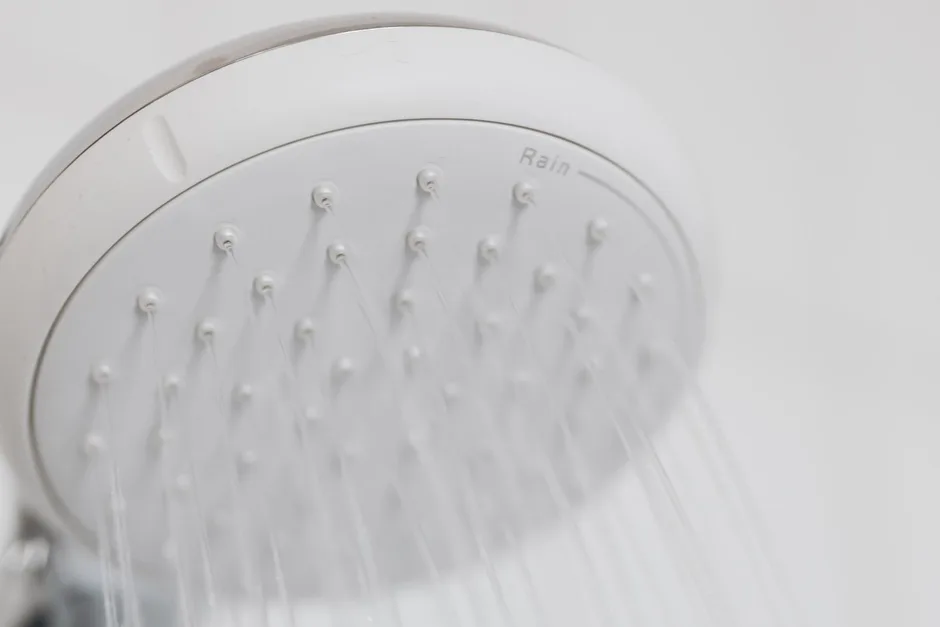
Rub your thumb firmly across the rubber nozzles. They are made to flex exactly so that whatever has lodged in them pops out. Rinse the head through backwards under a tap, refit the washer, and that is the repair.
Search this problem and page one will tell you to soak the head overnight in white vinegar to dissolve limescale. That advice is written for hard water and it does not describe what comes out of a Parramatta tap. Sydney's supply is soft, roughly 43 mg/L across the network and about 50 mg/L out of Prospect, against a threshold of 60 mg/L for water to count as hard at all. There is no meaningful scale here to dissolve. What blocks a rose locally is grit: sediment shaken loose off ageing galvanised supply pipe, still running in plenty of pre-1970s homes around Harris Park, North Parramatta and Granville, or stirred up after work on a main. Grit comes out with a thumb and a rinse. Vinegar does nothing to it.
5. Re-seal the thread and refit
If the leak was at the wall thread rather than the swivel, clean the old thread seal tape off the shower arm and re-wrap it, going clockwise as you look at the end of the thread, three or four turns, pulled snug into the grooves. Wrapping it the other way just unwinds the tape as the head goes on.
Then refit gently. This is where good intentions do real damage. That arm screws into a fitting inside the wall, and leaning on it with a wrench can crack or turn the fitting behind the tiles. You will not see that happen. You will see it a week later as a damp patch, and a $0 repair becomes an opened wall, a plumber and a tiler. Snug, then a nudge, then stop.
Be more careful again in the older housing stock. Around Harris Park, North Parramatta and Granville plenty of homes still run original galvanised steel supply pipe, corroding from the inside out, and an arm threaded into a fitting of that age has far less metal left in it than the shiny chrome outside suggests. If it does not want to move by hand, that is information, not a reason to find a bigger tool.
Run it for a minute and check all three points again with a dry finger. If it is dry, you are done.
6. When the drip means the tap, not the head
If new drops are still arriving thirty minutes after the taps went off, the head is a bystander. Water is passing the tap or the mixer cartridge and running out through the only opening it has. Cleaning the rose will not touch it, and neither will a new rose.
What fails is a washer, an O-ring, a cartridge, or the brass seat the washer closes onto. On a two-tap shower that is often still owner-or-occupier territory, because the Plumbing and Drainage Act names repairing a tap alongside the showerhead, and we have written that up in detail in our guide on what you may legally fix yourself on a leaking tap. On a single-lever mixer it usually is not, because the cartridge sits in a body set into the wall and getting at it is wall work.
That distinction has a second edge in a strata block. A tap you can unscrew from the tiled face is hardware on your side of the boundary. A mixer body buried in the wall may be sitting in common property, in which case the repair stops being a decision you get to make on your own and becomes a conversation with the owners corporation. There is more on that in section 13.
Either way, stop turning the taps harder. Every extra half turn against a worn seat cuts it a bit deeper and makes the eventual repair bigger.
7. Has water got behind the tiles?
This is the check almost nobody does, and in an apartment suburb it is the one with money attached. A slow leak at the wall thread does not run down the tiles into the waste. It runs into the wall.
Go and look at three places: the ceiling of the room directly below the bathroom, the skirting board on the other side of the shower wall, and the grout along the bottom course of tiles. You are looking for staining, a chalky bloom, lifting paint, or grout that stays dark long after the bathroom has dried out.
The National Construction Code is explicit about why that matters. Its performance requirement for wet areas, F2P2, states that to protect the structure of the building and maintain the amenity of the occupants, water must be prevented from penetrating "behind fittings and linings" and "into concealed spaces, of sanitary compartments, bathrooms, laundries and the like". In a Class 2 building, which covers essentially every apartment block in the Parramatta CBD and the Westmead high-rise belt, building elements in wet areas must be water resistant or waterproof and comply with AS 3740.
That is not theoretical here. Building Commission NSW publishes a Building Defects Library, and retained water, ponding or inadequate falls in the shower area is one of the waterproofing defects it lists, against the Australian Standard's requirement that the fall to the floor waste in a shower area be a minimum of 1:80. A shower floor that already holds water, plus a head quietly wetting the wall behind it, is how the ceiling below ends up stained. If your shower is also slow to clear, our guide on a blocked shower drain is the other half of that problem.
8. Book out the part that is not yours
The line is clean and it is worth holding. The head, its washer and its thread seal are yours. The tap body, the mixer cartridge, anything inside the wall, and the three named valves are not, and in NSW that is a licence matter rather than a matter of confidence. We put our licence number, 368473C, on every quote, and a proper visit traces where the water is actually starting instead of replacing the rose and hoping.
Drip that will not stop?
If new water is still arriving with the taps off, it is the tap. A licensed local plumber can sort it, 24/7.
9. Why shower heads fail around Parramatta
The physics of a shower head is the same everywhere. What is different here is what gets into it and what pushes on it.
Soft water, so it is wear and grit, not scale. This is the single biggest reason the standard internet answer misfires locally. Sydney's water is soft, so the descaling routine that dominates page one is solving a problem Parramatta does not have. Rubber perishes with age and heat cycling, and that is what actually kills a washer here.
Old supply pipe upstream. Plenty of housing around Harris Park, North Parramatta and Granville still runs on original galvanised steel, which corrodes from the inside out and sheds fine debris downstream for years before it ever fails properly. That debris ends up in the smallest holes in the house, and the holes in a shower rose are the smallest ones you own.
Pressure set by a building, not a street. Sydney Water aims to supply a minimum of 15 metres head of pressure at the point of connection, which it equates to a flow of 18 litres a minute at the garden tap. A tower cannot work off street pressure alone, so what arrives at a rose in the CBD or Westmead is decided by the building's own pumps and valves rather than by the main outside. Set high, it wears washers and o-rings faster everywhere in the building. Our guide on low water pressure around the house covers how to tell what you are actually getting.
And it is genuinely not costing you much. Worth saying plainly, because most articles on this oversell it. A new head under the Plumbing Code of Australia's minimum for new developments runs at no more than 9 litres a minute, and a drip is a tiny fraction of that. Fix a dripping shower head because of what it is telling you about the tap, and because of what it may be doing to the wall, not because of the bill.
10. Five things that make it worse
- Forcing the taps shut. The most common way a small drip becomes a resurfaced seat and a bigger repair.
- Overtightening the head onto the arm. The seal comes from the washer and the thread tape, not from force. Force cracks the fitting in the wall.
- Vinegar soaks and descalers. Written for hard water. On Parramatta's supply they achieve nothing and you have lost a weekend.
- Wrapping tape around the outside of a joint. Thread seal tape works inside the thread. Around the outside it hides the leak and keeps the water against the wall.
- Leaving a mark on someone else's ceiling. In a strata block, the longer a wall leak runs, the more of the repair stops being a plumbing job and starts being an insurance and by-laws job.
11. Urgent, or can it wait?
Honestly: a dripping shower head is almost never an emergency, and anyone who tells you otherwise at 9pm is selling a call-out. If it stops when the line drains, or it drips slowly and the wall stays dry, book it into normal hours and sleep.
Treat it as urgent if any of these are true:
- It is running rather than dripping and closing the taps does not stop it.
- There is staining, a damp patch or a bulge on a ceiling below, yours or a neighbour's.
- The water coming out on its own is hot, which points at a mixing or tempering fault rather than a worn washer.
- You have shut the taps, the drip continues, and you cannot find any way to isolate that shower.
One more that is specific to an apartment suburb: if the damp patch has appeared on somebody else's ceiling, treat it as urgent even though nothing in your own bathroom looks dramatic. Once water has crossed into another lot or into common property, the longer it sits the more of the job stops being plumbing and starts being paperwork, and in a NSW strata scheme that means the owners corporation, the by-laws and possibly an insurer are all in the room before anyone picks up a spanner.
Everything else can wait for a booked appointment, and we will tell you which one you have before anyone gets in a van.
12. Renting in Parramatta
This is the majority case here rather than a footnote. At the 2021 Census, 70.2% of Parramatta's occupied private dwellings were rented, 8,251 of them, against a NSW figure of about a third. If you are reading this in a Parramatta bathroom, the odds are you do not own it.
The Residential Tenancies Act 2010 lists urgent repairs, and one of them is an appliance, fitting or fixture that uses water, or is used to supply water, that is broken or not functioning properly "so that a substantial amount of water is being wasted". That is the test, and it is worth being straight about which side of it you are on. A head that drips a few times a minute is not wasting a substantial amount of water and is an ordinary repair request. A shower that will not shut off is, and then the urgent-repair rules apply.
If it does qualify and you cannot get hold of the landlord or agent, NSW rules let you arrange the repair yourself and be reimbursed up to $1,000, with the landlord or agent required to pay you back within 14 days of your notice. The conditions matter: use a repairer named in your tenancy agreement if there is one, otherwise a licensed or qualified tradesperson, and keep every receipt.
Cleaning the shower head yourself is legal under the Plumbing and Drainage Act, and it will not cost you anything. Going past the head into the tap or the wall to save the landlord a call-out is a different thing entirely: that is unlicensed plumbing work, and reimbursement is conditional on the repairs being carried out by a licensed or otherwise properly qualified person. You can end up having done illegal work and paid for it yourself, on a property you do not own.
13. In a flat? Who pays for what
In a suburb that is 85.6% apartments, "is this mine or the building's" is the real question behind most shower leaks. New South Wales publishes a common property memorandum that many schemes adopt to settle exactly this, and its plumbing item lands cleanly on this problem.
On the lot owner's side of item 8 are "taps and any associated hardware", which is where a shower head and its fittings sit, and "pipes, downstream of any stopcock, only serving that lot and not within any common property wall". On the owners corporation's side are "pipes within common property wall, floor or ceiling" and the "main stopcock to unit".
So the rose in your hand is yours. The pipework inside a common property wall is not. That is why step 2 is worth doing properly: a drip at the face of the rose is a fitting you own, and a leak at the wall may be feeding something you do not.
If it has got past the tiles, the memorandum splits that too. The owners corporation carries "original tiles and associated waterproofing affixed to the common property walls at the time of registration of the strata plan", while a lot owner carries tiles and associated waterproofing on non-common property walls, and floor tiles and waterproofing affixed by an owner after registration. In plain terms, original bathroom on a common wall tends to be the building's, and a renovation someone did later tends to be the lot's.
One caveat that matters: a scheme can choose to adopt the memorandum if its by-laws do not have their own definition of common property. Check your by-laws and your strata plan before anyone starts arguing, because the plan is what decides where your lot actually ends.
- Dry the head, close the taps, and look again at ten and thirty minutes. Drain-down stops. A leak does not.
- Water at the wall thread matters far more than water at the face, because it is going somewhere you cannot see.
- NSW law lets you repair a tap or showerhead in your own home, and excludes thermostatic mixing valves, tempering valves and backflow devices by name.
- Skip the vinegar. Sydney's water is soft, and what blocks a local rose is grit off old pipe, not scale.
- In a Parramatta flat, the head is yours and the pipe in a common property wall is not, and 70.2% of homes here are rented, which changes who you tell.
Leaking shower head FAQs
Can I replace a shower head myself in NSW?
Section 4(5)(e) of the Plumbing and Drainage Act 2011 puts repairing a tap or showerhead in your own dwelling outside the definition of plumbing and drainage work, along with fitting water-restricting or flow-regulating devices to tap end fittings including showerheads. It has to be done by the owner or occupier, or by someone they authorise who is not paid for it, and it specifically excludes any repair of a thermostatic mixing valve, tempering valve or backflow prevention device. Note the wording is repairing rather than replacing, and it covers the head, not the mixer body in the wall.
Will soaking the shower head in vinegar fix it?
Almost certainly not in Parramatta, and this is where most of the advice online goes wrong for Sydney. Vinegar soaks are written for hard-water regions where limescale genuinely blocks the nozzles. Sydney's water is soft, roughly 43 mg/L across the network and about 50 mg/L out of Prospect, against a threshold of 60 mg/L for water to be classed as hard at all. What blocks a rose here is grit shed by ageing galvanised supply pipe, or debris stirred up after work on a main, and a thumb across the rubber nozzles clears it in seconds.
My shower head drips for a while after I turn it off. Is that a leak?
Usually not. Water sitting in the head and the shower arm has to drain out, so a minute or two of drips is normal. A rail shower with a flexible hose holds more water and takes longer, and a ceiling-mounted rain head on a long drop can dribble for several minutes because there is a column of water in the pipe above it. The test is time, not volume: dry the head, shut the taps, and check at thirty minutes. New drops that late are new water under pressure, which means the tap is not sealing.
I rent in Parramatta. Is a leaking shower head an urgent repair?
It depends on how much water it is losing. The Residential Tenancies Act 2010 lists as an urgent repair an appliance, fitting or fixture that uses water or is used to supply water that is broken or not functioning properly so that a substantial amount of water is being wasted. A slow drip does not meet that and is an ordinary repair request to your agent. A shower you cannot shut off does. If it is urgent and you cannot reach the landlord or agent, you can arrange the repair and be reimbursed up to $1,000, payable within 14 days of your notice, provided a licensed or qualified tradesperson did the work.
Who pays in a Parramatta apartment, me or the owners corporation?
The NSW common property memorandum, where a scheme has adopted it, puts "taps and any associated hardware" and pipes downstream of any stopcock that serve only your lot and are not inside a common property wall on the lot owner. It puts "pipes within common property wall, floor or ceiling" and the "main stopcock to unit" on the owners corporation. So the shower head itself is yours, and pipework buried in a common wall generally is not. A scheme can only adopt the memorandum if its by-laws do not already define common property, so check your by-laws and your strata plan first.
Could a dripping shower head be why my water bill went up?
On its own, very unlikely. A drip is a tiny fraction of the flow a shower head is designed for, and the Plumbing Code of Australia's minimum for new developments is a head running at no more than 9 litres a minute. If your bill has jumped, the drip is a symptom rather than the cause, and the thing to check is the meter. Shut every tap and appliance, take a meter reading, wait, and take another. If the numbers move, something else is running, and a leak inside a wall or under the ground is the usual answer around here.