If you own one of the old cottages in Harris Park, North Parramatta or South Parramatta, the plumbing question is rarely "can this be fixed". It is "will council have something to say about it". The honest answer is that most plumbing work inside an old house needs no approval at all. Council cares about two things: what you can see from the street, and what happens when somebody digs.
This guide walks through the order to work it out: how to find out what kind of heritage protection your place actually has, which jobs need a form and which do not, where a new hot water unit is allowed to go, and what the City of Parramatta and the Heritage Act expect when a trench opens up in some of the oldest ground in the country. It covers City of Parramatta rules. If a pipe has already let go, stop reading and turn the water off first, then see our burst pipe guide.
Repairs and most interior plumbing in a Parramatta heritage home generally need no council consent, but on a listed house council still wants to hear about it first. Anything on the outside, like gutters, downpipes or a hot water unit visible from the street, goes through a Heritage Minor Works application or a DA. Any digging needs an archaeology check first, because parts of Parramatta sit on known historical deposits.
- Check whether the house is a listed item, in a conservation area, or both
- Sort the job into inside, outside or underground
- Lodge a Heritage Minor Works application for outside work like gutters
- Keep hot water units and tanks out of sight from the street
- Check the archaeology before anyone digs
- Choose the least invasive repair and keep the paperwork
On this page
- Check what kind of heritage your home is
- Sort the job: inside, outside or underground
- Outside work: lodge the minor works form
- Keep services out of sight
- Check the archaeology before digging
- Choose the least invasive repair
- Why heritage plumbing is different here
- Five things that make it worse
- When it cannot wait
1. Check what kind of heritage protection your home has
Look your address up on the NSW ePlanning Spatial Viewer before you plan anything, because "heritage" covers three quite different situations and the rules differ for each. The viewer pulls the Parramatta LEP 2023 and DCP controls together with the state heritage database, so one search tells you which one applies.
The three levels, from lightest to heaviest:
- In a heritage conservation area, but not itself listed. The street is protected as a group. Council's interest is mostly the street face of your house.
- A locally listed heritage item. The house itself is on Schedule 5 of the Parramatta LEP 2023. The City has over 1,300 of these, so this is far more common than people expect.
- On the State Heritage Register. The City has some 70 State items. Work on these is also assessed by Heritage NSW under the Heritage Act 1977, and council's general list of minor works may not apply. Talk to Heritage NSW before a plumber touches anything.
The conservation areas in our part of the city are North Parramatta, Sorrell Street, Burnside Homes, South Parramatta, Harris Park West, Experiment Farm, Elizabeth Farm and Tottenham Street in Granville. If you are buying, the Section 10.7 certificate from council shows whether the property is listed. Council's own advice on a listed property is to research it properly and consider a heritage consultant, and that advice is worth taking before you budget for a re-pipe.
2. Sort the job: inside, outside or underground
Once you know the level, sort the job by where the work physically happens, because that is how Parramatta's heritage controls are written. Inside work is usually the easy case, outside work usually needs a form, and underground work brings in archaeology as well.
Inside. Council's DCP says non-structural internal alterations to a house in a conservation area generally do not need consent, unless the interior itself is listed as significant. For a locally listed item, council says minor maintenance and most interior works that do not affect the structure can go through a Heritage Minor Works application rather than a full development application. Replacing a corroded pipe under the floor, swapping a cistern or re-running supply lines inside the walls is the kind of non-structural work those rules describe. Cutting through original walls, removing a chimney breast to run a flue, or reworking a significant interior does not.
Outside. Gutters, downpipes, vent pipes, wall-mounted units, anything fixed to a front or side wall. Covered in the next two steps.
Underground. Sewer and stormwater lines, a new water service, a soakage pit. Covered in step 5, and it is the one that catches people out.
Whatever the category, council strongly recommends a word with its Heritage Advisor before you start changing anything, and a pre-lodgement meeting if you are not sure whether the job is minor works or a DA. It costs a phone call and saves a stop-work letter.
3. For outside work, lodge a Heritage Minor Works application
If the job changes the outside of a listed house or a house in a conservation area, lodge a Heritage Minor Works application through council's Online Services before work starts. You choose Lodge an Application, then Development, then Heritage Minor Works, and attach the documents with full owner's consent.
For plumbers, the important part is that council's own examples of minor works include replacing or establishing gutters and downpipes, along with underpinning small areas and damp proofing. That covers most of the external plumbing on an old house. It is not a free pass to change materials, though. Council's DCP says replacing original materials with new modern ones on front or side walls needs consent, and that specially shaped gutters matter to the street appearance of historic houses and may need advice from a heritage consultant to source or fabricate.
In practice that means a like-for-like repair of an ogee or half-round gutter on a Harris Park cottage is the straightforward path. Swapping it for whatever profile is cheapest at the supplier is the one that turns a minor works form into a conversation. If the work goes beyond the minor works scope, council says that tells you a development application is needed.
4. Keep hot water units, tanks and vents out of sight from the street
When you replace a hot water system or add a rainwater tank, put it where it cannot be seen from the street or a public place. The Parramatta DCP writes this into the controls for the North Parramatta and Sorrell Street, South Parramatta, Harris Park West, Elizabeth Farm and Tottenham Street conservation areas, and the list covers hot water systems, rainwater tanks, roof vents, air conditioning units and solar panels.
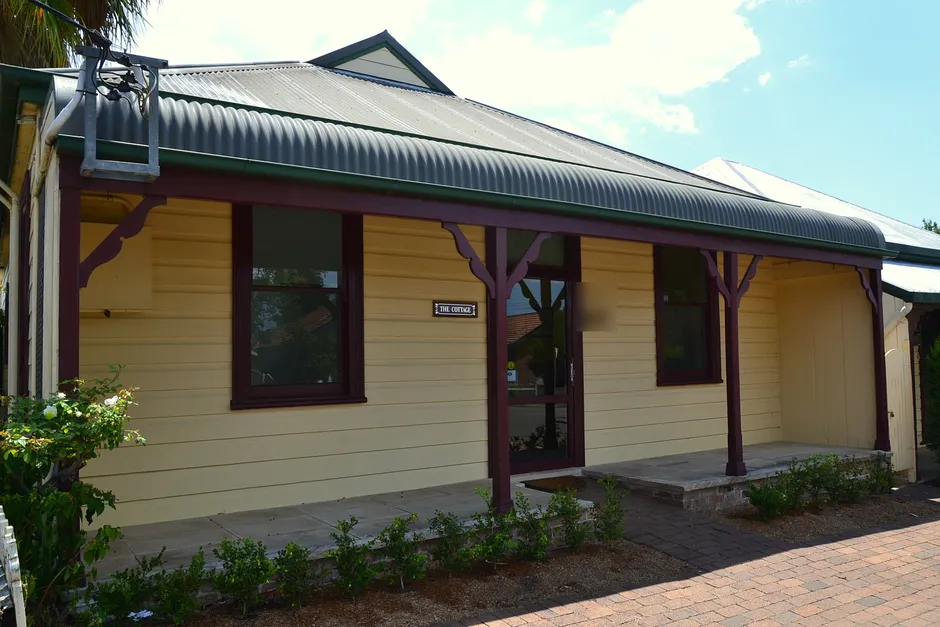
On these blocks that is usually less of a problem than it sounds. Harris Park West was subdivided in the 1870s and 1880s into narrow lots, mostly 30 feet wide, with back lanes, so the natural spot for a hot water unit is down the side behind the front building line or out the back. The thing to avoid is the shortcut: bolting a continuous-flow unit to the front wall because the gas line happens to run there, or putting a heat pump on the street side because the old tank sat in a front verandah cupboard.
Solar hot water and heat pumps raise the same question from a different angle. Panels on the street-facing roof plane fall under the same "not visible" control, so on a conservation area cottage the rear roof plane is where they belong. A heat pump or a gas unit tucked down the side usually solves it more simply, and our hot water team will plan the location around that before quoting, not after.
5. Check the archaeology before anyone digs
Before any trench opens, ask council whether the site has been identified as having archaeological significance. In Parramatta that is a real question, not a formality. The DCP notes that archaeological investigations here have shown a high likelihood of valuable material below ground, and its history of North Parramatta flags likely below-ground deposits from before 1846, when Roseneath, built around 1837, was almost the only house north of Fennell Street.
Here is how it works. Council keeps the Parramatta Historical Archaeological Landscape Management Study, known as PHALMS, which maps the city's archaeological resources and recommends how each site should be managed. Any development application in the PHALMS area that involves excavation has to address those recommendations, and if they call for it, an excavation permit from Heritage NSW comes before the digging. Some properties are named outright. The Elizabeth Farm controls list 61, 63 and 65 Alice Street as known sites of former Elizabeth Farm outbuildings, where any excavation needs an archaeological permit under the Heritage Act.
Two points keep this in proportion. First, council itself says there are no obligations on an owner or builder before starting work unless the site has been identified as containing relics, or as likely to, and that this applies to relatively few sites. Second, the Heritage Act sits over the top of whatever council requires. A relic is any object or deposit relating to the settlement of NSW that is more than fifty years old, and if one turns up unexpectedly, work has to stop and the Heritage Council must be notified under section 146. Heritage NSW says works stop at the site and the surrounding area until you get a formal response.
6. Choose the least invasive repair, and keep the paperwork
Ask for the repair that disturbs the least original fabric and the least ground, and get it done by a licensed plumber who leaves a paper trail. Parramatta's DCP says the depth and extent of excavation should be minimised where land contains or is likely to contain relics, and that is good plumbing practice anyway.
For a cracked or root-filled sewer under the front garden of an old cottage, that usually points to a camera inspection first and pipe relining second, because the liner goes in through an existing access point instead of a new trench through the garden and the archaeology. Inside, it means running new pipe through the subfloor or existing penetrations rather than chasing original plaster, and leaving old fittings that still work alone.
Keep everything: the Heritage Minor Works approval, the Certificate of Compliance the plumber lodges, the camera footage and the invoice. A future buyer's heritage consultant will ask for it. If you plan to apply to council's Local Heritage Fund, note that a Heritage Minor Works application is mandatory before you can apply, so lodge it even for work you think might not need one.
Planning work on an old Parramatta home?
We will camera the drains, map what is original, and quote the least invasive fix first.
7. Why heritage plumbing is different in Parramatta
Plenty of Sydney suburbs have old houses. Parramatta's are older than most, they sit on ground that moves, and some of them sit on top of the colony itself.
The houses are genuinely old. Most of Harris Park West was built before 1895. In South Parramatta, the Detail Survey of 1895 recorded 104 buildings in what is now the conservation area, and 47 of them are still standing. Ten houses survive from the slow building that followed the 1856 auction of Meehan's grant, and all of them stand on or close to the front fence, which leaves very little front garden between the house and the street for a water service or a sewer line to cross. North Parramatta was surveyed for the sewerage system in 1895, by which time the area had filled with cottages, many from the 1880s building boom.
The pipes are the original vintage. Old earthenware sewer was laid in short lengths with mortared joints that were never watertight. Galvanised steel supply lines rust from the inside. Both are common under these cottages, and both fail at the joints first.
The ground works against them. Much of Parramatta sits on Wianamatta shale, which weathers to a reactive clay that swells when wet and shrinks when dry. Over decades that movement opens old earthenware joints, and roots follow the moisture in. If that sounds familiar, our tree roots guide covers what actually clears them.
The archaeology is real. Elizabeth Farm, begun in 1793, is described in council's DCP as the oldest surviving European building on the continent. Experiment Farm is the land where Governor Phillip set James Ruse up in 1789. Old Government House and its Domain in Parramatta Park was inscribed on the World Heritage List in 2010 as one of the 11 Australian Convict Sites. A trench in these streets is a different proposition to a trench in a 1990s estate.
And it is not hard water. Sydney's water is soft, so an old hot water system in a heritage home fails for the same reasons as any other here: age, a spent anode or a failed element, not scale.
8. Five things that make it worse
- Starting outside work and asking afterwards. Council recommends talking to its Heritage Advisor before work starts. A gutter replaced in the wrong profile can mean paying for it twice.
- Putting the new hot water unit on the street face. It is the most visible mistake on a heritage frontage, and the one the conservation area controls name directly.
- Digging a new trench when there was another way. Excavation is where archaeology, protected trees and the front garden all become problems at once. Relining or reusing an old trench line avoids most of it.
- Carrying on when something old turns up. Bottles, brick footings, an old well or a cesspit in the trench is a reason to stop and notify, not to backfill quickly.
- Using an unlicensed handyman because "it is only an old house". Plumbing in NSW must be done by a licensed plumber, and heritage work needs the Certificate of Compliance trail more than most.
9. When it cannot wait, and when it can
A burst pipe, a sewer overflowing into the yard or a gas smell does not wait for paperwork. Turn the water off at the main, make it safe, and call. Council's controls treat maintenance and repair as the minor end of the scale. The approvals that take time are about changes to the street face and new excavation, so if the permanent fix involves either, that is the part you take to council once the emergency is over.
Everything else can wait for a proper plan. A slow drain, a weeping gutter joint, a hot water system you know is on its last legs: these are the jobs worth a camera inspection, a call to the Heritage Advisor and a written quote before anyone starts. We will tell you honestly which side of that line you are on, and if it is a job that genuinely does not need us, we will say so. For drains specifically, our blocked drains page explains how we find the fault before we quote.
- Find out first whether the house is in a conservation area, locally listed, or on the State Heritage Register. The ePlanning Spatial Viewer tells you.
- Most interior plumbing and repairs need no consent, but on a listed house use a Heritage Minor Works application and talk to council first.
- Gutters and downpipes go through Heritage Minor Works. Match the original profile.
- Hot water units, tanks and solar belong out of sight from the street in Parramatta's conservation areas.
- Before digging, check PHALMS and the archaeology. If something old turns up, stop and notify.
Heritage home plumbing FAQs
Do I need council approval to replace the hot water system in a Harris Park cottage?
The control that matters is about where it goes. Harris Park West is one of the conservation areas where the DCP says hot water systems should not be visible from the street or a public place, so a new unit in the same hidden spot at the side or rear stays clear of it, while moving it to the front wall or a street-facing roof is what brings council in. If the house is individually listed, talk to council's Heritage Advisor before you commit to a location.
My house is in a conservation area. Does that mean it is heritage listed?
Not necessarily. A conservation area protects the street as a group, while a heritage item is a property listed in its own right on Schedule 5 of the Parramatta LEP 2023. Some houses are both. The NSW ePlanning Spatial Viewer shows which applies to your address, and a Section 10.7 certificate confirms it when you buy.
Can I replace old gutters and downpipes on a heritage home in Parramatta?
Yes. Council lists replacing or establishing gutters and downpipes as minor works, which go through a Heritage Minor Works application rather than a full development application. Replacing original materials with modern ones on front or side walls needs consent, and specially shaped gutters may need a heritage consultant's advice to match.
What happens if the plumber finds something old while digging in North Parramatta?
Work stops. Under section 146 of the Heritage Act 1977 the Heritage Council has to be notified of a relic, which is any object or deposit relating to the settlement of NSW that is more than fifty years old. Heritage NSW says works stop at the site and surrounding area until it gives a formal response. Parramatta's DCP notes a high likelihood of valuable archaeological material below ground here.
Can I put solar hot water on the roof of a house in a Parramatta conservation area?
On the rear roof plane, usually. The DCP controls for North Parramatta, South Parramatta, Harris Park West, Elizabeth Farm and Tottenham Street say solar panels and hot water systems should not be visible from the streetscape or a public place, which rules out the street-facing side. A heat pump or gas unit at the side or rear avoids the question.
Will relining my sewer need heritage approval?
Relining works inside the existing pipe through an existing access point, so it avoids the new excavation that brings in Parramatta's archaeology controls. That is the main reason it suits old cottages here. If an access pit has to be dug, ask council first whether the site is identified as having archaeological significance.